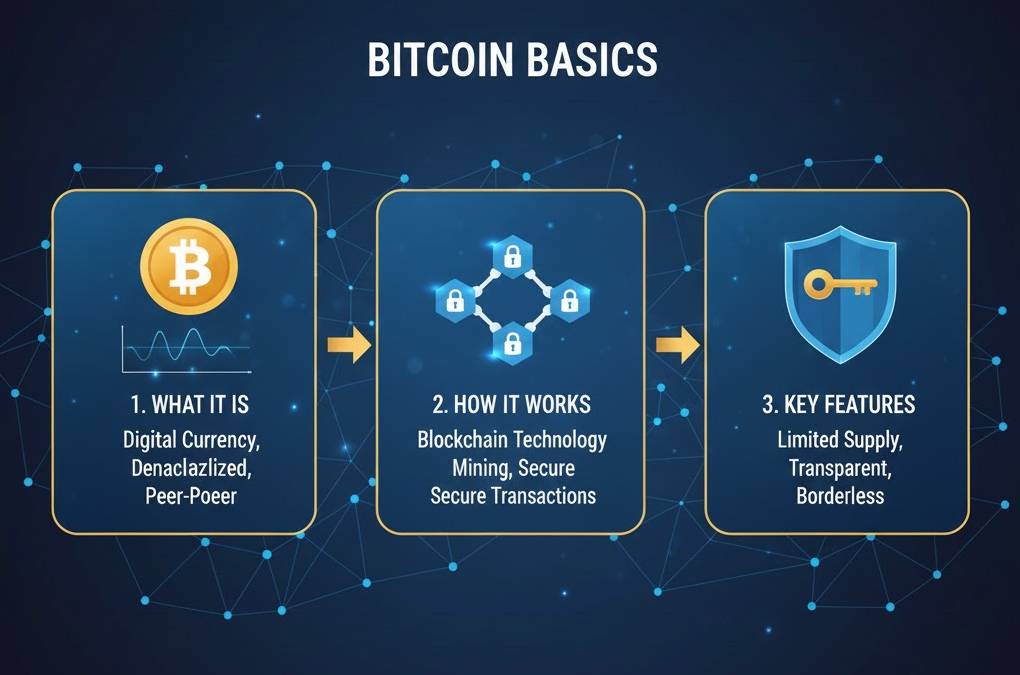
Bitcoin Basics: What Is Bitcoin and How Does It Work?
Learn Bitcoin basics: what is Bitcoin, how blockchain works, mining, and why it matters. Complete beginner's guide to the world's first cryptocurrency.
Bitcoin Basics: What Is Bitcoin and How Does It Work?
Bitcoin is the world's first cryptocurrency and the foundation of the entire crypto ecosystem. In this guide, we'll explain what Bitcoin is, how it works, and why it matters in today's digital economy.
What Is Bitcoin?
Bitcoin is a digital currency created in 2009 by an anonymous person or group using the pseudonym Satoshi Nakamoto. Unlike traditional currencies issued by governments or central banks, Bitcoin is decentralized—meaning no single entity controls it. Instead, the Bitcoin network is maintained by thousands of independent computers (called nodes) worldwide.
Bitcoin operates on a technology called blockchain, which is a distributed ledger that records all transactions in a transparent and immutable way. This makes Bitcoin resistant to fraud, censorship, and government control.
Key Characteristics of Bitcoin
- Decentralized: No central authority controls Bitcoin. It's managed by the network itself.
- Limited Supply: Only 21 million Bitcoin will ever exist, making it scarce by design.
- Transparent: All transactions are recorded on the public blockchain and can be verified by anyone.
- Secure: Uses advanced cryptography to protect against fraud and unauthorized access.
- Peer-to-Peer: Allows direct transactions between users without intermediaries.
How Bitcoin Works
Understanding how Bitcoin works involves understanding several key components:
The Blockchain
The blockchain is a digital ledger that records every Bitcoin transaction ever made. Think of it as a public record book that everyone can see and verify. When a transaction occurs, it's broadcast to the network, verified by miners, and then permanently recorded in blocks that are linked together chronologically.
Bitcoin Addresses
Bitcoin users receive funds to Bitcoin addresses, which are long strings of alphanumeric characters (e.g., 1A1z7agoat). Each address is associated with a private key—a secret code that proves ownership and allows you to spend the Bitcoin. Losing your private key means losing access to your Bitcoin permanently.
Mining
Bitcoin mining is the process by which new Bitcoin transactions are verified and new Bitcoin is created. Miners use powerful computers to solve complex mathematical puzzles. The first miner to solve the puzzle gets to add a new block to the blockchain and receives Bitcoin as a reward. This process currently happens approximately every 10 minutes.
The Bitcoin Supply
Bitcoin has a fixed maximum supply of 21 million coins. New Bitcoin is created through mining rewards, but this reward is cut in half every 4 years in an event called "halving." Here's the timeline:
- 2009-2012: 50 Bitcoin per block
- 2012-2016: 25 Bitcoin per block
- 2016-2020: 12.5 Bitcoin per block
- 2020-2024: 6.25 Bitcoin per block
- 2024+: 3.125 Bitcoin per block (and continuing to halve)
Why Bitcoin Matters
Financial Freedom
Bitcoin enables financial transactions without relying on banks or governments. This is particularly important for people in countries with unstable currencies, strict capital controls, or limited banking infrastructure.
Inflation Protection
Because Bitcoin's supply is limited, it cannot be printed indefinitely like fiat currency. This makes Bitcoin a potential hedge against inflation and currency devaluation.
Innovation Catalyst
Bitcoin's success launched the entire cryptocurrency and blockchain industry. Thousands of other cryptocurrencies and blockchain applications have been built following Bitcoin's model.
Store of Value
Many people view Bitcoin as "digital gold" — a store of value similar to precious metals that holds its worth over time.
Bitcoin Pricing and Volatility
Bitcoin's price is determined by supply and demand in the market. The price has been highly volatile, ranging from under $100 in the early years to over $60,000+ in recent years. Several factors affect Bitcoin's price:
- Market adoption and institutional investment
- Regulatory developments
- Macroeconomic conditions
- Media coverage and public sentiment
- Halving events and mining difficulty
- Technology upgrades
Getting Started with Bitcoin
Step 1: Get a Wallet
You need a Bitcoin wallet to store your Bitcoin. Wallets come in different forms: mobile apps, desktop software, hardware devices, or online services. Choose one that balances security and convenience for your needs.
Step 2: Buy Bitcoin
You can buy Bitcoin on cryptocurrency exchanges like Coinbase, Kraken, or Binance using fiat currency (dollars, euros, etc.). See our guide on "How to Buy Bitcoin" for detailed instructions.
Step 3: Store Safely
Secure your private keys and consider using cold storage (offline wallets) for large amounts of Bitcoin. Never share your private keys or seed phrases with anyone.
Step 4: Stay Informed
The crypto market moves fast. Stay updated on news, security best practices, and technological developments.
Bitcoin vs. Traditional Money
| Feature | Bitcoin | Traditional Money |
|---|---|---|
| Decentralized | Yes | No (government controlled) |
| Supply Cap | 21 million (fixed) | Unlimited |
| Transaction Speed | ~10 minutes per block | 1-3 days (banks) |
| Borders | Global, borderless | Subject to regulations |
| Transparency | Fully transparent | Opaque (private banks) |
Common Misconceptions
Bitcoin Is Illegal
Bitcoin is legal in most countries. Some restrict or regulate cryptocurrency use, but it's not banned worldwide. Always check your local regulations.
Bitcoin Is Only for Criminal Activity
While Bitcoin's anonymity makes it attractive to bad actors, most Bitcoin transactions are legitimate. The blockchain's transparency makes it traceable, making it less suitable for criminal activity than cash.
Bitcoin Uses Unlimited Energy
Bitcoin does consume significant energy, but estimates vary. The network is increasingly powered by renewable energy, and improvements like Lightning Network reduce energy consumption per transaction.
Bitcoin's Price Will Keep Rising
Bitcoin is highly volatile. Past performance doesn't guarantee future results. Always invest responsibly and only what you can afford to lose.
The Future of Bitcoin
Bitcoin's future remains uncertain but exciting. Potential developments include:
- Wider Adoption: More companies and institutions may accept Bitcoin as payment
- Government Recognition: Some countries may adopt Bitcoin as legal tender
- Technology Upgrades: Layer 2 solutions and improvements may increase transaction speed
- Regulatory Clarity: Clear regulations may increase institutional investment
Conclusion
Bitcoin is a revolutionary technology that introduced cryptocurrency and blockchain to the world. While it's not without challenges, Bitcoin remains the most valuable and widely recognized cryptocurrency. Whether Bitcoin is a good investment depends on your financial goals, risk tolerance, and time horizon.
Remember: Bitcoin is highly volatile and risky. Only invest what you can afford to lose, do your own research, and consider consulting with a financial advisor.