Blockchain Explained: Blocks, Chains, and Consensus
Learn how blockchain technology works: blocks, chains, consensus, mining, immutability, decentralization. Complete guide to blockchain fundamentals.
Blockchain Technology Explained: Complete Beginner's Guide
Blockchain is the revolutionary technology powering cryptocurrencies and transforming industries worldwide. This comprehensive guide explains what blockchain is, how it works, its key features, and real-world applications.
What Is Blockchain?
Blockchain is a distributed ledger technology that records transactions across multiple computers in a secure, transparent, and immutable manner. Instead of relying on a single central authority to maintain records, blockchain distributes the ledger across a network of computers (called nodes), where each node holds an identical copy of the data.
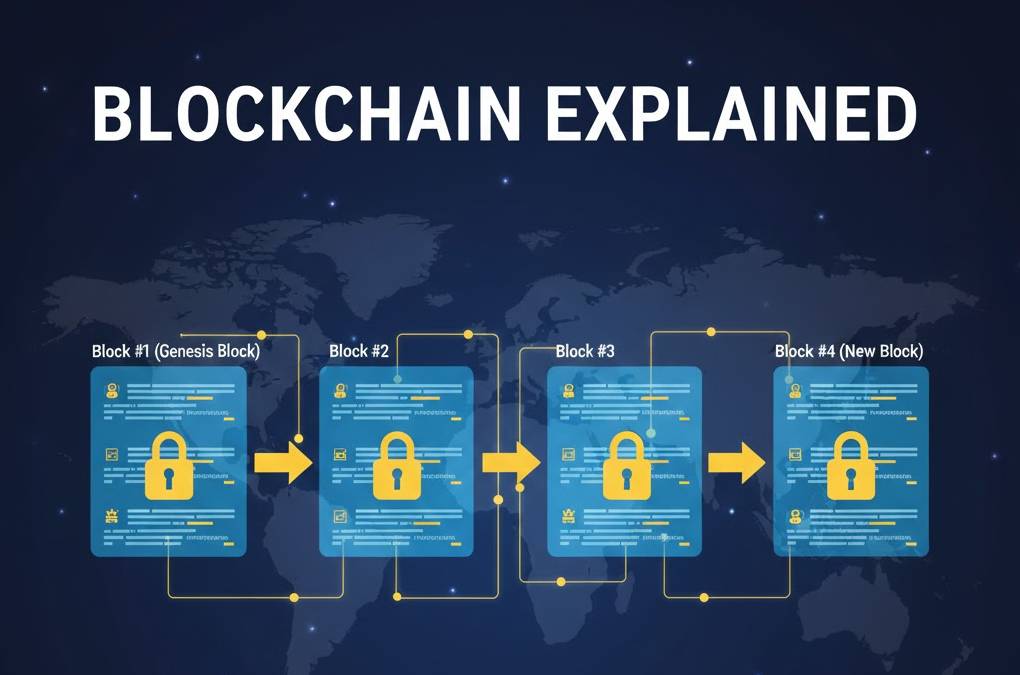
The term "blockchain" comes from how the technology works: data is organized into "blocks" that are cryptographically "chained" together in chronological order. Each block contains a list of transactions and references the previous block, creating an unbreakable chain of historical records.
Blockchain was first introduced in 2008 as the underlying technology for Bitcoin, the world's first cryptocurrency. Since then, it has evolved far beyond cryptocurrency to enable applications in supply chain management, healthcare, voting systems, and many other industries.
Key Characteristics of Blockchain
- Decentralization: No single point of control or failure. The network is managed collectively by all participants.
- Transparency: All transactions are visible to all participants. Everyone can verify the integrity of the data.
- Immutability: Once data is recorded on the blockchain, it cannot be altered or deleted without detection.
- Security: Uses advanced cryptographic algorithms to protect data integrity and ensure authenticity.
- Consensus Mechanism: Requires agreement among network participants before adding new data, preventing fraudulent transactions.
How Blockchain Works: The Technical Foundation
Understanding blockchain requires understanding its core components and how they interact to create a secure, distributed system.
Blocks: The Building Blocks of Blockchain
A block is a data structure that contains a batch of transactions or records. Each block typically includes:
- Block Header: Contains metadata about the block including timestamp, version, and difficulty target.
- Transactions: The actual data or transactions recorded in the block.
- Hash: A unique cryptographic fingerprint of the block created using a hash function.
- Previous Block Hash: A reference to the hash of the previous block, creating the chain.
- Merkle Root: A hash representing all transactions in the block, ensuring transaction integrity.
- Nonce: A number used in the mining process (Proof of Work).
The hash of a block is calculated based on its contents. Even the smallest change in a block's data would produce a completely different hash. This property is crucial for blockchain security—any attempt to tamper with a block would be immediately detected because its hash would no longer match the reference stored in the next block.
The Chain: Linking Blocks Together
Blocks are linked together chronologically through cryptographic hashes. Each block contains the hash of the previous block, creating an immutable chain. If someone tries to alter data in an old block, its hash changes, which breaks the chain. This would require recalculating all subsequent blocks' hashes, which is computationally infeasible due to the amount of processing power required.
This chaining mechanism is what makes blockchain tamper-resistant. The further back in the chain a block is located, the more difficult it becomes to alter, as all subsequent blocks would need to be recalculated.
Consensus Mechanisms: How Networks Agree
In a decentralized blockchain network, there's no central authority to validate transactions. Instead, the network uses consensus mechanisms—rules that allow all participants to agree on which transactions are valid and should be added to the blockchain.
Proof of Work (PoW)
Proof of Work is the consensus mechanism used by Bitcoin and many other blockchains. In PoW, miners compete to solve complex mathematical puzzles. The first miner to solve the puzzle gets to add the next block to the blockchain and receives a reward (newly created cryptocurrency plus transaction fees).
The puzzle difficulty adjusts automatically to maintain consistent block creation time (approximately 10 minutes for Bitcoin). This makes attacking the network extremely expensive because attackers would need to control more computing power than the rest of the network combined.
Proof of Stake (PoS)
Proof of Stake is an alternative consensus mechanism used by Ethereum 2.0 and other modern blockchains. Instead of miners solving puzzles, validators are chosen to create new blocks based on the amount of cryptocurrency they hold and are willing to "stake" (lock up as collateral).
If a validator acts maliciously or tries to approve fraudulent transactions, they lose their staked cryptocurrency (called "slashing"). This economic incentive ensures honest behavior without requiring massive computational power. PoS is more energy-efficient than PoW.
Other Consensus Mechanisms
Beyond PoW and PoS, other consensus mechanisms include:
- Delegated Proof of Stake (DPoS): Token holders vote for delegates who validate transactions.
- Practical Byzantine Fault Tolerance (PBFT): Validators reach consensus through multiple rounds of voting.
- Proof of Authority (PoA): Pre-approved validators (often known entities) validate transactions.
Mining: Creating New Blocks
In Proof of Work blockchains, mining is the process of validating transactions and creating new blocks. Miners are incentivized by block rewards and transaction fees. Mining serves two critical purposes:
- Transaction Validation: Miners verify that transactions are legitimate and follow the network's rules.
- New Block Creation: Miners bundle verified transactions into blocks and add them to the blockchain.
The mining process requires significant computational power. Miners use specialized hardware (ASIC chips for Bitcoin) and organize into mining pools to share work and rewards. Mining difficulty adjusts automatically so new blocks are added at a consistent rate regardless of total network computing power.
Key Properties: Why Blockchain Is Powerful
Immutability: Permanent Records
Once data is recorded on a blockchain, it cannot be altered without immediately breaking the chain of cryptographic hashes. Changing a transaction in block #100 would change its hash, which would require updating block #101's reference to block #100, which would change block #101's hash, and so on for every subsequent block.
This cascading effect makes tampering computationally infeasible, especially for Bitcoin and other large networks where recalculating millions of blocks would require more computing power than exists globally.
Decentralization: No Single Point of Failure
Traditional databases are stored in one location controlled by one organization. If that organization is hacked, the entire database is compromised. Blockchain distributes data across thousands of computers worldwide, each maintaining a full copy of the ledger.
An attacker would need to simultaneously compromise the majority of these independent nodes across different jurisdictions and with different security practices—an extremely difficult task. This distributed nature makes blockchain resistant to censorship and government control.
Transparency: Verifiable Records
All transactions on a public blockchain are visible to everyone. While users are identified by addresses rather than names (pseudonymous, not anonymous), their transaction history is completely transparent and verifiable.
This transparency enables independent verification of data without trusting a central authority. Anyone can download the entire blockchain and verify every transaction independently.
Smart Contracts: Programmable Blockchain
Smart contracts are self-executing programs stored on the blockchain. They automatically execute when predetermined conditions are met, without requiring intermediaries.
For example, a smart contract could automatically transfer cryptocurrency when certain conditions are fulfilled, or execute complex business logic entirely on-chain. Ethereum popularized smart contracts and allows developers to write them in languages like Solidity.
Smart contracts revolutionized blockchain by enabling decentralized applications (dApps) for lending, trading, insurance, gaming, and countless other use cases. However, smart contracts are only as good as their code—bugs can be exploited, and code vulnerabilities have led to significant losses in the past.
Real-World Use Cases
Cryptocurrency and Digital Payments
The original use case—Bitcoin as digital money. Cryptocurrencies enable peer-to-peer value transfer without banks, particularly valuable in countries with unstable currencies or limited banking infrastructure.
Supply Chain Management
Blockchain records every step of a product's journey from manufacturer to consumer. This enables transparent tracking, verifies authenticity, reduces counterfeiting, and improves food safety by enabling rapid tracing of contamination sources.
Healthcare Records
Patient medical records can be stored on blockchain, giving patients control over their data while ensuring secure sharing with healthcare providers. Medical history is immutable and follows patients across providers.
Voting Systems
Blockchain-based voting systems can enable transparent elections resistant to fraud. Votes are recorded immutably and can be verified by the voter and independent observers.
Digital Contracts and Legal Documents
Smart contracts can enforce agreements without lawyers or intermediaries. Digital contracts execute automatically when conditions are met, reducing costs and delays.
Intellectual Property and Royalties
Artists, musicians, and creators can use blockchain to prove ownership, manage royalties, and receive payments directly from consumers without intermediaries like record labels.
Blockchain Limitations and Challenges
Scalability
Blockchain networks process transactions slowly compared to centralized systems. Bitcoin processes ~7 transactions per second while Visa handles thousands. Solutions like Layer 2 protocols and sharding are being developed to improve scalability.
Energy Consumption
Proof of Work blockchains require massive computing power, consuming significant electricity. Bitcoin's annual energy consumption rivals some countries. Proof of Stake addresses this but remains energy-intensive compared to centralized systems.
Irreversibility
Transactions cannot be reversed. If you send cryptocurrency to the wrong address or fall victim to fraud, recovery is nearly impossible. This immutability is a feature for security but a liability for user errors.
Regulatory Uncertainty
Blockchain's decentralized nature challenges traditional regulatory frameworks. Different countries have varying approaches to cryptocurrency and blockchain regulation, creating legal uncertainty.
User Experience
Managing private keys and navigating blockchain applications remains complex for average users. Improved user interfaces and custody solutions are needed for mainstream adoption.
Quantum Computing Threat
Future quantum computers may be able to break current cryptographic algorithms. Blockchain developers are working on quantum-resistant algorithms to address this potential future threat.
Different Types of Blockchains
Public Blockchains
Open to anyone, fully decentralized, and transparent. Examples: Bitcoin, Ethereum. No single entity controls access or can censor transactions.
Private Blockchains
Access restricted to approved participants. Often used by enterprises for efficiency while maintaining some blockchain benefits. Less decentralized than public blockchains.
Consortium/Hybrid Blockchains
Partially decentralized, controlled by multiple organizations. Common in enterprise settings where several companies cooperate but don't trust each other completely.
The Future of Blockchain
Blockchain technology continues evolving rapidly. Key developments include:
- Improved Scalability: Layer 2 solutions and next-generation blockchains enabling millions of transactions per second.
- Interoperability: Bridges between different blockchains enabling seamless asset transfer.
- Privacy Enhancements: Zero-knowledge proofs and privacy-preserving technologies for confidential transactions.
- Enterprise Adoption: More Fortune 500 companies exploring blockchain for supply chain, healthcare, and financial applications.
- Central Bank Digital Currencies (CBDCs): Government-backed digital currencies on blockchain rails.
- Sustainability: Shift toward energy-efficient consensus mechanisms and green blockchain initiatives.
Conclusion
Blockchain is a transformative technology that fundamentally changes how we record, verify, and transfer data. By enabling decentralization, transparency, and immutability without requiring trust in a central authority, blockchain opens possibilities for innovation across industries.
While challenges remain around scalability, energy consumption, and regulation, blockchain's potential is enormous. Whether you're interested in cryptocurrency, supply chain management, healthcare innovation, or other applications, understanding blockchain fundamentals is increasingly valuable in our digital economy.
As blockchain technology matures and becomes more user-friendly, adoption is likely to accelerate. The next decade will reveal which blockchain applications create lasting value and transform industries, and which prove to be temporary hype.