Smart Contracts Explained: Self-Executing Code Guide

Smart contracts are self-executing programs that automatically enforce agreements on blockchain. Learn how they work, their applications in DeFi, and the risks you should understand.

Introduction to Smart Contracts

Smart contracts represent one of the most transformative innovations in blockchain technology. They are self-executing programs that automatically enforce and execute agreements without intermediaries. Instead of relying on lawyers, banks, or other middlemen to verify and enforce contracts, smart contracts use code to create agreements that execute exactly as written. This shift from traditional contracts to smart contracts eliminates the need for trust in third parties. The code itself becomes the law—immutable, transparent, and automatically enforced. Understanding how smart contracts work and their implications is essential for anyone interested in cryptocurrency and blockchain technology.
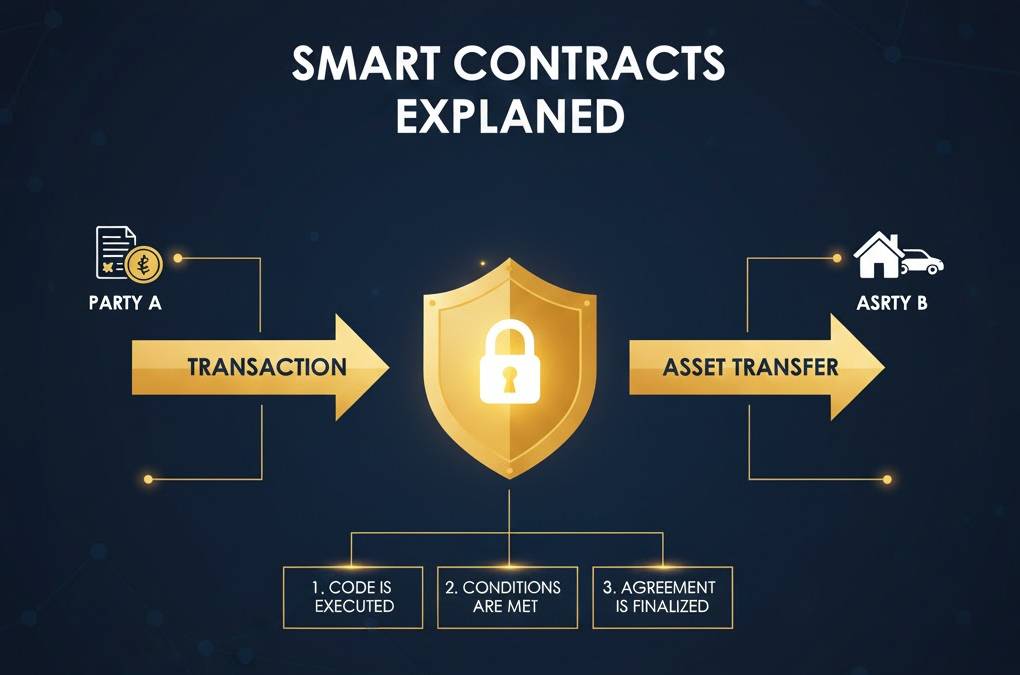
## How Smart Contracts Work ### The Basic Mechanism A smart contract is fundamentally a program deployed on a blockchain. When predetermined conditions are met, the contract automatically executes its code. The execution is deterministic, meaning it always produces the same result given the same inputs, making it reliable and predictable. Here's the basic workflow: 1. **Contract Creation**: A developer writes contract code and deploys it to the blockchain. This deployment costs a small fee (called gas on Ethereum) and creates a permanent record on the blockchain. 2. **Trigger Event**: Something happens that should activate the contract. This might be a transaction, a specific price being reached, or a specific time passing. 3. **Condition Verification**: The contract checks whether predetermined conditions are met. For example, "Did the payment arrive?" or "Has the deadline passed?" 4. **Automatic Execution**: If conditions are satisfied, the contract automatically executes its programmed actions. These actions might transfer funds, mint tokens, update records, or trigger other contracts. 5. **Immutable Record**: Every execution is recorded on the blockchain and cannot be reversed or tampered with. ### The Blockchain Infrastructure Smart contracts only work because of blockchain technology's unique properties. Blockchains are distributed networks where thousands of independent computers (nodes) maintain identical copies of a ledger. When a smart contract executes: - All nodes verify the execution independently - All nodes reach consensus on the result - The result is recorded permanently across all nodes - No single entity can reverse or change the outcome This distributed verification ensures that smart contracts execute exactly as coded, without fraud or manipulation. ## Programming Languages and Platforms ### Ethereum and Solidity Ethereum is the blockchain platform most associated with smart contracts. Ethereum introduced Solidity, a programming language specifically designed for creating smart contracts. Solidity resembles JavaScript and is relatively beginner-friendly, contributing to Ethereum's dominance in smart contract development. Ethereum currently processes millions of smart contract executions daily, ranging from simple token transfers to complex decentralized finance protocols managing billions of dollars. ### Other Platforms While Ethereum pioneered smart contracts, other blockchain platforms have emerged with their own smart contract capabilities: **Polygon** offers Solidity-based smart contracts with much lower fees than Ethereum mainnet, making it suitable for applications where transaction costs matter. **Cardano** uses Plutus, a functional programming language that emphasizes security and verification. Cardano's design makes certain classes of bugs impossible. **Solana** features smart contracts called "programs" written in Rust, providing different security and performance tradeoffs than Ethereum. **Bitcoin** has Tapscript, a limited smart contract language designed for specific use cases rather than general-purpose programming.
## Smart Contract Applications ### Decentralized Finance (DeFi) Smart contracts power the entire DeFi ecosystem. Automated Market Makers like Uniswap use smart contracts to create trustless trading without order books or central exchanges. Users deposit funds into smart contracts, which automatically handle trading, price discovery, and reward distribution. Lending protocols like Aave allow users to deposit cryptocurrency and earn interest, all controlled by smart contracts that calculate interest rates, manage collateral, and prevent default. These protocols operate 24/7 without employees or management, purely through code execution. ### Token Creation and Management Smart contracts enable the creation of tokens following standard specifications like ERC-20 (for fungible tokens). These contracts manage token transfers, balances, approvals, and supply. The standardization means tokens created via ERC-20 contracts work seamlessly with wallets, exchanges, and other applications. ### Insurance and Derivatives Smart contracts can create parametric insurance products. For example, a smart contract might automatically pay a claim if a temperature reading falls below a threshold, triggering a payment without human assessment. This eliminates processing delays and fraud. ### Governance and DAOs Decentralized Autonomous Organizations (DAOs) use smart contracts to implement governance. Token holders vote on proposals, and winning proposals automatically execute through smart contracts. This enables organizations run entirely by code and community consensus. ### Supply Chain and Verification Smart contracts can track assets through supply chains, recording ownership transfers and verifications. Medical, luxury goods, and food supply chains benefit from smart contracts creating transparent, tamper-proof records. ## Benefits of Smart Contracts ### Elimination of Intermediaries Traditional contracts require lawyers, brokers, escrow agents, and other intermediaries, adding cost and time. Smart contracts eliminate these middlemen, reducing costs and accelerating execution. What once took days now happens in minutes. ### Transparency and Trust Smart contract code is typically open source and deployable by anyone for verification. This means you don't need to trust the developer—you can examine the code yourself. Everyone sees the exact logic governing the agreement. ### Immutability and Certainty Once deployed, smart contract code cannot be changed, and execution cannot be reversed without intentional provisions in the code itself. This provides certainty that the agreement will execute exactly as written. ### Efficiency and Speed Smart contracts execute instantly when triggered, operating 24/7 without human intervention. Processes that once took hours or days through traditional channels now complete in seconds. ### Cost Reduction By eliminating intermediaries and automating processes, smart contracts substantially reduce operational costs. These savings can be passed to users in the form of lower fees. ## Risks and Limitations ### Coding Errors and Bugs Smart contracts are only as good as their code. A single bug can have catastrophic consequences because the contract executes deterministically and permanently. The 2016 DAO hack exploited a code vulnerability, resulting in the loss of $50 million worth of Ethereum. ### Immutability Liability While immutability provides security, it also means mistakes cannot be undone. If a contract bugs out and sends funds to the wrong address, there's no customer service to contact. You've lost those funds permanently. ### Oracle Problem Smart contracts operating on blockchain cannot directly access external data. Oracles—services that feed external data onto the blockchain—are necessary for many applications. If an oracle is compromised or fails, smart contracts relying on it can malfunction. ### Scalability Constraints Blockchain networks have limited throughput. Ethereum processes only about 15 transactions per second on mainnet, creating congestion and high fees during periods of high demand. This limits smart contract applications and costs. ### Regulatory Uncertainty Smart contracts occupy legal gray areas. A contract that executes perfectly in code might violate laws or regulations. For example, a smart contract managing real estate might conflict with local property laws. ## Smart Contract Security Best Practices **Code Audits**: Before deploying smart contracts with significant value, independent security firms should audit the code. Professional audits cost thousands of dollars but prevent potentially catastrophic losses. **Testing**: Extensive testing on testnet before mainnet deployment catches many bugs. Test edge cases and attack vectors thoroughly. **Upgradeability**: Using proxy patterns allows code to be upgraded if vulnerabilities are discovered, though this reduces immutability. **Insurance**: Platforms like Nexus Mutual provide insurance for smart contract failures, transferring risk to insurance providers. **Bug Bounties**: Projects often offer rewards for researchers who responsibly disclose vulnerabilities before exploitation. ## The Future of Smart Contracts Smart contracts continue evolving with improved programming languages, better security tools, and increased scalability. Layer 2 solutions will enable cheap, fast smart contract execution. Improved oracles will bring reliable external data onchain. Better programming languages will make bugs less likely. Smart contracts are transitioning from experimental technology to foundational infrastructure. They're moving from simple token transfers to managing real-world assets, insurance, governance, and complex financial instruments. ## Conclusion Smart contracts represent a fundamental shift in how agreements and programs operate. By replacing human intermediaries with deterministic code, they enable entirely new classes of applications and organizations. While challenges remain—particularly around security and scalability—smart contracts have already transformed finance and will continue reshaping how we organize economic and social systems. Understanding how they work is essential for participating in the blockchain economy.