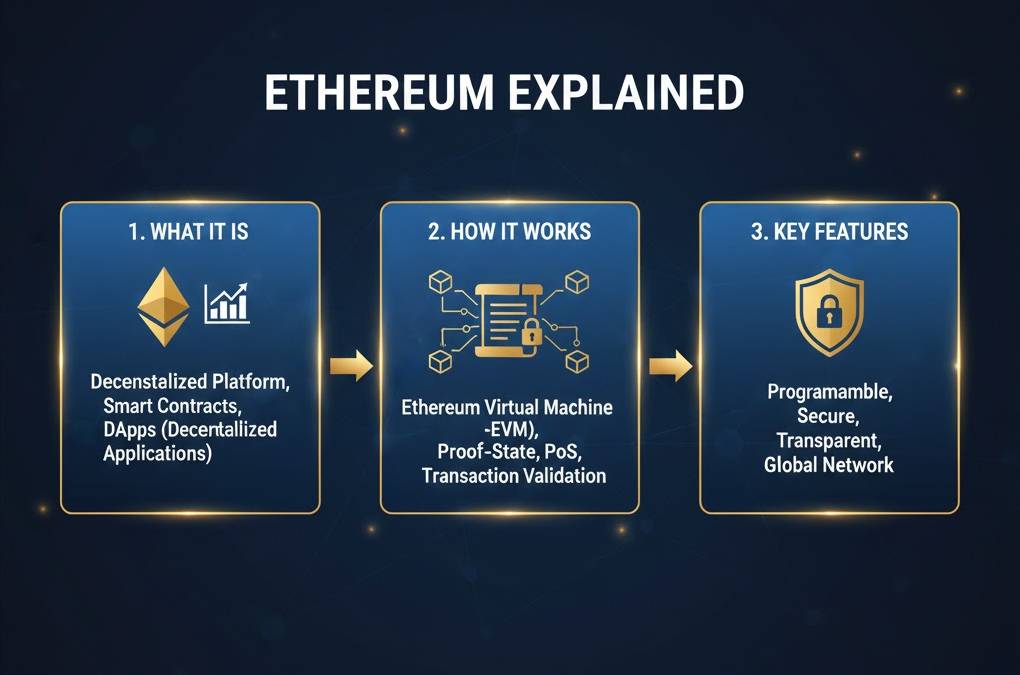
Ethereum Explained: Complete Guide to the Network & Blockchain
Complete Ethereum guide: Learn smart contracts, dApps, and how Ethereum differs from Bitcoin. Explore the network powering decentralized applications.
Ethereum Explained: Complete Guide to the Network & Blockchain
Ethereum is the second-largest cryptocurrency and the foundation for decentralized applications (dApps). This guide explains what Ethereum is, how it works, and why it's fundamental to the crypto ecosystem.
What Is Ethereum?
Ethereum is a decentralized blockchain network created in 2015 by Vitalik Buterin and other developers. While Bitcoin was designed primarily as digital currency, Ethereum was designed as a platform for running decentralized applications (dApps) and smart contracts.
The Ethereum network uses a cryptocurrency called Ether (ETH) to power the network and incentivize participants. ETH is the second-most valuable cryptocurrency by market cap, after Bitcoin.
Key Characteristics
- Smart Contracts: Self-executing code that runs on the blockchain
- dApps Platform: Hosts thousands of decentralized applications
- Turing Complete: Can run any computational logic
- ERC Standards: Standardized token formats for interoperability
- Proof of Stake: Transitioned to energy-efficient consensus (as of 2022)
Ethereum vs. Bitcoin
| Feature | Ethereum | Bitcoin |
|---|---|---|
| Primary Purpose | Smart contracts & dApps | Digital currency |
| Block Time | 12-13 seconds | ~10 minutes |
| Programming | Turing complete (full coding) | Limited scripting |
| Supply | Unlimited (controlled emission) | 21 million cap |
| Consensus | Proof of Stake (2022+) | Proof of Work |
Smart Contracts Explained
A smart contract is a self-executing program stored on the blockchain. It automatically executes when predetermined conditions are met, without requiring intermediaries.
Smart Contract Example
Imagine a betting contract: two people agree to bet on the outcome of a sports game. They deposit funds into a smart contract. When the game ends, the contract automatically checks the result and distributes funds to the winner—all without a middleman.
Why Smart Contracts Matter
- Automation: No need for lawyers or intermediaries
- Transparency: Everyone can see the contract code and execution
- Security: Cryptographically secured and tamper-proof
- Efficiency: Instant execution and settlement
How Ethereum Works
The Ethereum Virtual Machine (EVM)
The EVM is a virtual computer that runs on every Ethereum node. When a smart contract is deployed, the EVM executes its code. This allows smart contracts to run consistently across the entire network.
Gas and Transaction Fees
To use Ethereum (send transactions, deploy contracts, etc.), you pay a fee called "gas." Gas is paid in small units of ETH called "Wei." Gas prices fluctuate based on network demand—when the network is busy, gas prices are higher.
Types of Ethereum Accounts
- Externally Owned Accounts (EOAs): User accounts controlled by private keys
- Contract Accounts: Accounts containing smart contract code
Ethereum 2.0 and Proof of Stake
In September 2022, Ethereum successfully transitioned from Proof of Work (mining) to Proof of Stake (staking). This major upgrade changed how new blocks are created and secured.
Proof of Stake Benefits
- 99.95% Less Energy: Dramatically reduced energy consumption
- Faster Transactions: More efficient block production
- Increased Security: Validators put up collateral, incentivizing honest behavior
- Staking Rewards: Users can earn rewards by staking ETH
What Are dApps?
Decentralized Applications (dApps) are applications built on smart contracts. Unlike traditional apps controlled by companies, dApps run on the blockchain without centralized control.
Popular Ethereum dApps
- Uniswap: Decentralized exchange (DEX) for trading tokens
- Aave: Lending and borrowing protocol
- OpenSea: NFT marketplace
- Curve Finance: Stablecoin exchange
- MakerDAO: Decentralized stablecoin protocol
ERC Token Standards
Ethereum has standardized token formats that define how tokens should behave:
ERC-20
The standard for fungible tokens (interchangeable). Most cryptocurrencies on Ethereum use ERC-20.
ERC-721
The standard for non-fungible tokens (NFTs). Each token is unique and cannot be exchanged one-to-one.
ERC-1155
Multi-token standard supporting both fungible and non-fungible tokens in a single contract.
Ethereum Staking and Validators
After the transition to Proof of Stake, anyone can become a validator by staking 32 ETH. Validators earn rewards for proposing and validating blocks.
Staking Rewards
Staking rewards on Ethereum typically range from 3-5% annually, depending on network participation. This makes Ethereum staking an attractive way to earn passive income.
Layer 2 Solutions
To address scalability issues, Ethereum has developed Layer 2 solutions that process transactions off-chain and settle on-chain periodically:
- Arbitrum: Optimistic rollup offering low fees and fast transactions
- Optimism: Another optimistic rollup with good developer experience
- Polygon: Sidechain offering Ethereum compatibility with lower fees
Ethereum Use Cases
Decentralized Finance (DeFi)
Borrowing, lending, trading, and earning yield without traditional financial institutions.
Non-Fungible Tokens (NFTs)
Digital ownership of artwork, collectibles, and virtual items.
Decentralized Autonomous Organizations (DAOs)
Organizations controlled by smart contracts and token holders rather than traditional management.
Identity and Credentials
Self-sovereign identity systems that put users in control of their data.
Challenges and Limitations
High Gas Fees
During network congestion, transaction fees can be expensive. Layer 2 solutions help mitigate this.
Speed Limitations
Ethereum processes slower than centralized systems. Scalability improvements are ongoing.
Environmental Concerns
Though Proof of Stake reduced energy use dramatically, Ethereum still requires significant computing power.
The Future of Ethereum
Ethereum's roadmap includes:
- Dencun Upgrade: Further optimizations for Layer 2s
- Proto-danksharding: Massive scalability improvements
- Increased Decentralization: More staking options and validator diversity
Conclusion
Ethereum revolutionized blockchain by enabling programmable smart contracts and decentralized applications. While Bitcoin is digital money, Ethereum is a platform for decentralized computing. Together, they form the foundation of the crypto ecosystem.
Whether investing in Ethereum or using dApps, understanding how Ethereum works is essential for navigating the crypto space.