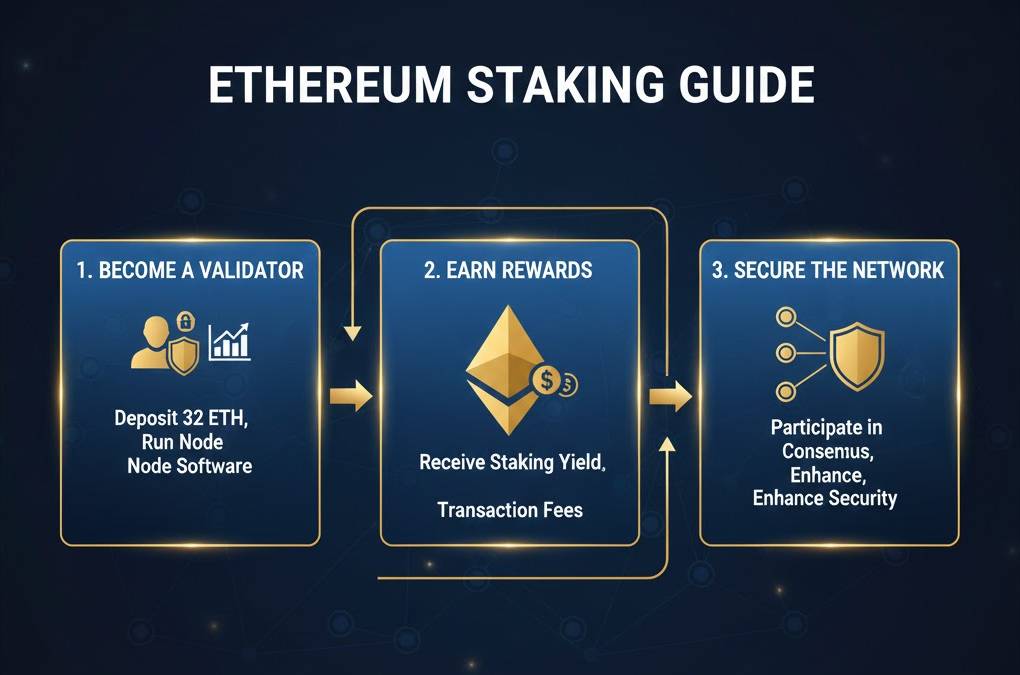
Ethereum Staking Guide: Earn Passive Income - Complete Tutorial
Complete Ethereum staking guide: earn passive income, understand APY, choose staking methods, calculate returns, and maximize rewards on Ethereum 2.0.
Ethereum Staking Guide: Earn Passive Income - Complete Tutorial
Ethereum staking allows you to earn passive income by validating transactions on the Ethereum network. This comprehensive guide explains how staking works, different staking methods, expected returns, and how to get started earning rewards on your Ethereum.
What Is Ethereum Staking?
Ethereum staking is the process of locking up your ETH to participate in validating the Ethereum blockchain. Validators who stake ETH are randomly selected to propose new blocks, and in return, they earn rewards in the form of additional ETH.
Staking replaced the old mining system when Ethereum transitioned from Proof of Work to Proof of Stake in September 2022 (called "The Merge"). This shift made Ethereum significantly more energy-efficient while allowing token holders to earn rewards.
How Ethereum Staking Works
Here's the process:
- Deposit ETH: You lock up 32 ETH (or less with staking pools) to become a validator
- Activation: Your validator joins the network after a waiting period
- Attestation: You validate blocks and earn rewards (around 100 times per day)
- Proposing: Occasionally, you're selected to propose new blocks (rare for most validators)
- Rewards: You earn ETH for each successful action
- Exit: You can unstake your ETH anytime, though there may be a queue
Key Concepts
- Validator: An individual or entity staking ETH to validate the network
- Attestation: Confirming a block is valid (happens frequently)
- Proposal: Creating a new block (rare, about once every 10 years per validator)
- Slashing: Penalty for malicious behavior (rare and severe)
- APY: Annual Percentage Yield - your annual return rate
Ethereum Staking APY and Returns
Current Staking Rewards
Ethereum staking APY varies based on network conditions and total staked ETH. Currently, staking returns are approximately 3%-4% annually, though this varies:
- Base Rewards: Determined by the protocol (~3% currently)
- Proposition Rewards: Additional rewards for proposing blocks (modest amount)
- MEV Rewards: Maximum Extractable Value—rewards from transaction ordering (0.1%-0.5% additional)
Example Returns:
- 32 ETH at 3.5% APY = 1.12 ETH per year (~$2,800 at $2,500 ETH price)
- 100 ETH at 3.5% APY = 3.5 ETH per year (~$8,750)
How APY Is Calculated
Ethereum staking APY depends on:
| Factor | Impact on APY | Current Status |
|---|---|---|
| Total ETH Staked | More staked = lower APY | ~30M ETH staked (24% of supply) |
| Network Activity | More transactions = higher rewards | Varies by day/time |
| Validator Count | More validators = shared rewards | ~950,000 validators |
| MEV (Miner Extractable Value) | Bonus rewards on top of APY | 0.1%-0.5% additional |
Why APY Decreases as More People Stake
As more ETH is staked, the protocol generates the same total rewards but divides them among more validators. If total protocol rewards are fixed at 500,000 ETH yearly:
- With 10M ETH staked: 500,000/10M = 5% APY
- With 20M ETH staked: 500,000/20M = 2.5% APY
- With 30M ETH staked: 500,000/30M = 1.67% APY
We're currently in the 3%-4% range, which is still attractive compared to traditional savings accounts.
Methods of Staking Ethereum
1. Solo Staking (32 ETH Required)
How it works: Run your own validator node and stake exactly 32 ETH. You control your keys and earn 100% of rewards.
Requirements:
- 32 ETH (~$80,000 at $2,500/ETH)
- Computer running consensus and execution clients (24/7 uptime)
- Technical knowledge (moderate to high)
- Internet connection with 25 GB download/month
Advantages:
- Maximum rewards (no middleman taking fees)
- Full control over your validator
- Contributes to Ethereum's decentralization
- Better for privacy (validators aren't identified)
Disadvantages:
- High capital requirement (32 ETH minimum)
- Technical setup and maintenance
- Downtime penalties (missing validations costs rewards)
- Time commitment for updates and troubleshooting
- If validator misbehaves, you get slashed (lose part of stake)
2. Liquid Staking (Any Amount)
How it works: Use services like Lido, Rocket Pool, or Frax that pool ETH from many users. You deposit any amount and receive liquid staking tokens (stETH, rETH, frxETH) that represent your stake.
Key Services:
- Lido (stETH): Largest liquid staking protocol, ~9.5M ETH staked
- Rocket Pool (rETH): Decentralized, community-run pools
- Coinbase Wrapped Staked Ether (cbETH): Coinbase's liquid staking token
Advantages:
- Stake any amount (even 0.01 ETH)
- Receive liquid tokens you can trade or use in DeFi
- No technical setup required
- Automatic reward distribution
- Easy unstaking (though you may need to wait)
Disadvantages:
- Fees (Lido takes 10% of rewards, others vary)
- Smart contract risk (could be exploited)
- Counterparty risk (trust the protocol operator)
- Price difference between token and underlying ETH (usually minimal)
3. Centralized Exchange Staking (Any Amount)
Services: Coinbase, Kraken, Binance, and others offer staking directly in their platforms.
Advantages:
- Simplest to use (one-click staking)
- Stake any amount
- No technical knowledge needed
- Instant staking (no waiting)
Disadvantages:
- High fees (Coinbase takes 25% of rewards)
- Exchange holds your ETH (counterparty risk)
- May not get staking tokens (can't use elsewhere)
- Regulatory uncertainty (staking regulations are evolving)
4. Staking Pools (Any Amount)
How it works: Community-run pools like Rocketpool that operate decentralized validator networks.
Advantages:
- Decentralized (no central authority)
- Modest fees (typically 10-15%)
- Receive liquid tokens
- Community governed
Disadvantages:
- More complex than exchange staking
- Smart contract risk
- Less user support than exchanges
Choosing the Right Staking Method
For Beginners with Small Amounts (1-32 ETH)
Use Lido or Rocket Pool. They offer simplicity without excessive fees (10-15% vs. 25% at exchanges). You'll receive liquid tokens to hold or use in DeFi.
For 32+ ETH and Technical Users
Solo staking maximizes rewards. If you're not technical enough to run validators, use Lido or Rocket Pool instead.
For Absolute Simplicity
Use Coinbase or Kraken staking. Yes, the 25% fee is high, but if you're a complete beginner, the simplicity and peace of mind may be worth it.
For DeFi Users
Use Lido or Rocket Pool to get liquid staking tokens (stETH, rETH) that you can use in lending protocols, yield farming, or trading on DEXs.
Step-by-Step: Getting Started with Lido Staking
Step 1: Acquire ETH
Buy ETH on an exchange like Coinbase, Kraken, or Binance.
Step 2: Set Up Wallet
Transfer ETH to a Web3 wallet like MetaMask, Ledger, or Argent.
Step 3: Go to Lido.fi
Visit https://lido.fi and connect your wallet.
Step 4: Stake Your ETH
Click "Stake" and enter the amount of ETH to stake. You'll get stETH in return.
Step 5: Receive Rewards
Your stETH balance grows daily as you earn rewards (currently ~3.5% APY minus 10% fee = ~3.15% net).
Step 6: Unstake (Optional)
You can unstake anytime by exchanging stETH back for ETH, though there may be a withdrawal queue.
Staking Calculator: Projecting Your Returns
Example: Staking 10 ETH at 3.5% APY (Net 3.15% After Lido Fee)
| Time Period | ETH Balance | Rewards Earned | Total Value (at $2,500 ETH) |
|---|---|---|---|
| Year 1 | 10.315 ETH | 0.315 ETH | $25,787.50 |
| Year 3 | 10.961 ETH | 0.961 ETH | $27,402.50 |
| Year 5 | 11.647 ETH | 1.647 ETH | $29,117.50 |
| Year 10 | 13.632 ETH | 3.632 ETH | $34,080 |
This assumes no change in ETH price and consistent 3.15% net APY—actual results depend on network conditions and APY variations.
Risks and Considerations
Slashing Risk
Validators who act maliciously can be "slashed"—having part of their stake destroyed. However, this is extremely rare (only happens for intentional attacks or severe bugs). Standard mistakes like validator downtime cost only rewards, not principal.
Smart Contract Risk
Liquid staking protocols use smart contracts, which could be exploited. However, most major protocols are heavily audited and have been battle-tested.
ETH Price Risk
Ethereum's price can fluctuate. If ETH falls 50%, your staking rewards don't offset the loss. Staking is best for long-term holders who believe in ETH's value.
Regulatory Risk
Staking's regulatory status is evolving. Some jurisdictions may regulate staking (particularly exchange staking), affecting taxation or availability.
Liquidity Risk (Unstaking)
While you can always sell liquid staking tokens immediately, unstaking through official channels may have a queue depending on network conditions.
Taxation and Staking Rewards
Tax Treatment
Staking rewards are generally treated as ordinary income in most jurisdictions:
- You owe taxes on rewards when received
- You may owe capital gains taxes on rewards when sold (if value increased)
- Taxed at your ordinary income rate in the US
Tax Planning
- Track your staking rewards (most platforms show this)
- Record the fair market value of ETH on the date rewards were received
- Keep this for tax filing and proof of income
- Consult a tax professional familiar with crypto (tax treatment is complex and jurisdiction-specific)
Advanced Staking Strategies
Staking + DeFi Yields
Use liquid staking tokens (stETH) in DeFi protocols to earn additional yields:
- Lend stETH on Aave for lending rewards
- Provide stETH/ETH liquidity on Curve for swap fees (LP farming)
- Use stETH as collateral to borrow other assets
Restaking
Advanced protocols like EigenLayer allow stakers to earn additional rewards by committing to additional validation services. This offers higher returns but additional risk.
Ethereum Staking's Future
Several developments will shape staking's future:
- Shanghai Upgrade (Complete): Enabled unstaking (previously locked indefinitely)
- Dencun Upgrade (Complete): Reduced data costs via blobs, affecting MEV rewards
- Increasing Validator Count: As more stake, APY may decrease further
- Regulatory Clarity: Governments defining staking taxation and regulation
- Competitive Returns: DeFi and other protocols improving to compete with staking
Conclusion
Ethereum staking offers an attractive way to earn passive income with your ETH holdings. Whether you choose simple exchange staking, liquid staking protocols like Lido, or run your own solo validator, the opportunity to earn 3-4% annually while supporting the Ethereum network is compelling. Start small, understand the risks, and consider staking a core part of your long-term crypto strategy.