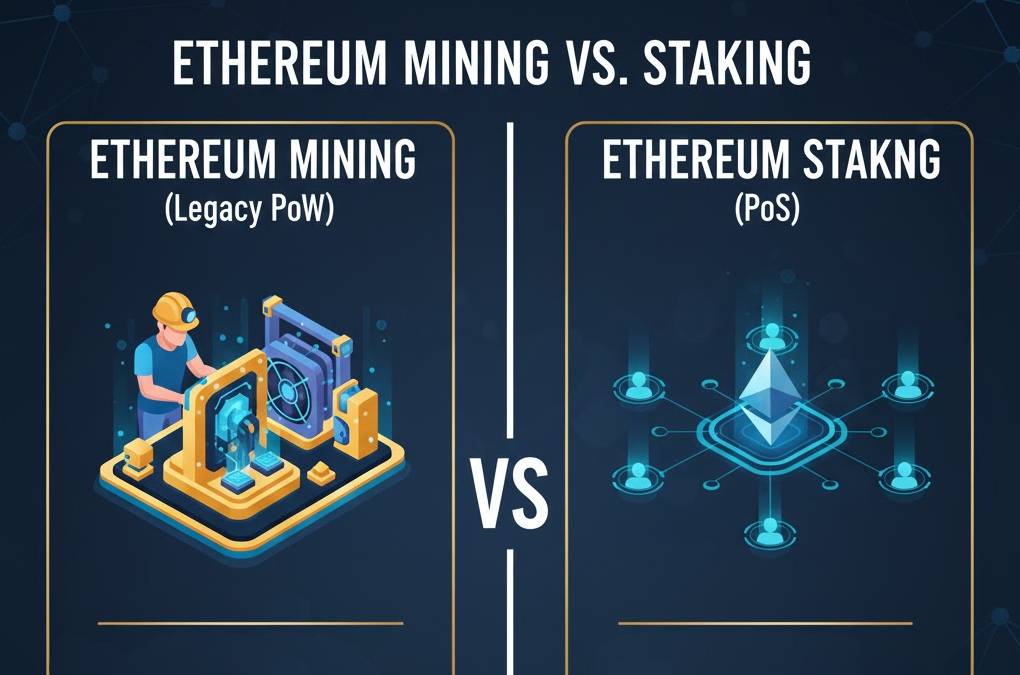
Ethereum Mining vs Staking: Profitability Comparison Guide
Compare Ethereum mining vs staking: profitability, requirements, returns, and which is better for earning passive income on Ethereum.
Ethereum Mining vs Staking: Which Earns More?
Ethereum's transition to Proof of Stake eliminated mining entirely, making staking the only official way to validate the network and earn rewards. But how do these approaches compare? This comprehensive guide analyzes profitability, technical requirements, capital needs, and which strategy works best for different situations.
Understanding the Ethereum Transition
What Changed During The Merge?
On September 15, 2022, Ethereum completed "The Merge"—transitioning from Proof of Work (mining) to Proof of Stake (staking). This was the most significant upgrade in Ethereum's history, eliminating GPU mining while enabling staking as the network's validation mechanism.
Before The Merge, Ethereum miners solved complex mathematical puzzles to validate blocks. After The Merge, validators locked up ETH to perform the same function. This shift wasn't just technical—it fundamentally changed how people earn from Ethereum validation.
Why Did Ethereum Make This Change?
Several factors motivated the transition:
- Energy Efficiency: Staking uses 99.95% less energy than mining
- Decentralization: Lower barriers enable more participants
- Security: Proof of Stake provides better economic security
- Scalability: PoS enables easier network improvements
- Environmental Sustainability: Massive carbon footprint reduction
Ethereum Mining: The Pre-Merge Era
How Mining Worked
Ethereum miners used powerful graphics processing units (GPUs) to compete solving cryptographic puzzles. The first miner to solve each puzzle got to add a block to the blockchain and received rewards—initially 5 ETH per block, later reduced to 2 ETH.
Mining profitability depended on several factors: hardware cost, electricity price, Ethereum's price, and network difficulty. Miners in countries with cheap electricity (Iceland, El Salvador, parts of China) had significant advantages.
Mining Equipment Requirements
Viable Ethereum mining required serious hardware investment:
- GPU Cards: High-end cards like RTX 3090 ($1,500-2,000 each)
- Mining Rigs: 6-8 GPUs per rig requires $10,000-16,000
- Power Supply: Heavy-duty PSU ($1,000-2,000)
- Cooling Equipment: Mining generates extreme heat ($2,000-5,000)
- Total Initial Investment: $15,000-25,000 minimum for viable mining
Mining Profitability During Its Height
At Ethereum's peak, mining was extremely profitable. In May 2021, a single RTX 3090 generated $20-25 daily. A rig with 8 cards earned $160-200 daily, or $50,000+ annually. Even accounting for $5,000 annual electricity, ROI was exceptional.
However, profitability was volatile. As more miners joined and difficulty increased, rewards per GPU dropped. By September 2022, GPU mining returned only $2-5 daily per high-end card, making new hardware investment uneconomical.
Barriers to Mining
- High upfront capital requirements ($15,000-50,000+)
- Significant electricity consumption and costs
- Hardware can become obsolete as difficulty increases
- Noise, heat, and space requirements
- Technical knowledge needed for configuration and maintenance
Ethereum Staking: The Post-Merge Reality
How Staking Works
Ethereum staking eliminates hardware mining entirely. Validators lock up 32 ETH to become active validators. The network randomly selects validators to propose new blocks and attest to existing ones. For successful validation work, stakers earn new ETH rewards—currently around 3-4% annually.
Unlike mining's competitive puzzle-solving, staking is democratic. Every validator has an equal chance of selection, independent of hardware. A node running on a $500 laptop has identical earning potential to one on a $10,000 server.
Staking Requirements
Solo staking (running your own validator) requires surprisingly modest resources:
- 32 ETH: The mandatory lockup (worth $80,000-120,000 depending on price)
- Hardware: Mid-range laptop or old PC ($500-1,500)
- Internet: Reliable connection (1 Mbps sufficient)
- Technical Knowledge: Moderate—many guides available
- Time: ~10 hours initial setup, minimal ongoing maintenance
Staking Reward Structure
Ethereum staking rewards consist of three components:
| Reward Type | Annual Percentage | Description |
|---|---|---|
| Consensus Rewards | ~2.5-3.5% | Base rewards for attestations |
| Proposition Rewards | ~0.1-0.3% | Bonus for proposing blocks |
| MEV Rewards | ~0.3-0.7% | Maximum extractable value from block ordering |
Staking Profitability Examples
With 32 ETH at current 3.5% APY:
- Annual rewards: 1.12 ETH (~$2,800-4,500 depending on price)
- Monthly rewards: ~0.093 ETH (~$230-375)
- The $500 hardware investment is recovered in 2-3 months of rewards
Compared to mining at its peak, staking offers reliable returns with zero hardware degradation and minimal electricity costs. A mining rig's earnings decreased constantly; staking's APY remains relatively stable regardless of network growth.
Mining vs Staking: Direct Comparison
Capital Requirements
Mining: $15,000-50,000 for viable hardware setup. This was necessary but equipment depreciated rapidly and became technically obsolete.
Staking: 32 ETH required (~$80,000-120,000). This is higher but it's in the validation asset itself, not depreciating hardware. ETH can be unstaked anytime, retaining full value.
Winner for low capital: Mining (past) had lower requirements, but staking today requires much less total investment relative to potential.
Technical Difficulty
Mining: Required hardware assembly, BIOS configuration, driver installation, overclock tweaking, and ongoing monitoring. Most miners eventually joined pools to simplify complexity.
Staking: Running a validator node is more straightforward. Modern staking UIs like Staking Launchpad guide users through steps. Alternatively, liquid staking protocols handle the complexity entirely.
Winner: Staking (modern approaches eliminate most complexity)
Profitability Per Unit Invested
Mining Peak: At peak profitability, $1,000 in GPU hardware earned $1,000-1,500 annually. ROI was exceptional but declining daily.
Staking Current: 32 ETH earning 3.5% annually generates $2,800-4,500 depending on ETH price. ROI is stable, not declining, and improves if ETH appreciates.
Winner: Current staking (peak mining was better, but that era is gone)
Operational Costs
Mining: Electricity was massive. A rig consuming 2,400W running 24/7 costs $3,000-7,000 annually in electricity (varies by region). Hardware maintenance, cooling, replacement—all significant expenses.
Staking: Electricity for a validator node is minimal ($50-200 annually). Zero hardware degradation. Some validators pay for cloud hosting ($10-50 monthly) to ensure uptime.
Winner: Staking (dramatically lower operational costs)
Volatility and Risk
Mining: Profitability crashed when Ethereum difficulty soared or price plummeted. A $20,000 mining rig could generate only $1,000 annually during bear markets. Hardware risk also existed—cards failed, became obsolete.
Staking: Rewards are proportional to stake and network conditions, not hardware viability. Staking risk is primarily Ethereum price risk (if ETH crashes 50%, rewards don't compensate). However, no hardware obsolescence risk exists.
Winner: Staking (more predictable and stable)
Staking Approaches Beyond Solo Validation
Liquid Staking Protocols
Not everyone has 32 ETH or wants to run hardware. Liquid staking solved this through protocols like Lido, Rocket Pool, and Coinbase Staking. You deposit ETH and receive liquid staking tokens (stETH, rETH) representing your stake. You earn staking rewards while retaining liquidity—you can sell your tokens anytime.
Tradeoffs: Liquid staking involves protocol fees (10-15% of rewards), adds smart contract risk, but enables staking with any amount (even 0.01 ETH).
Exchange Staking
Coinbase, Kraken, and other exchanges offer staking. You deposit ETH and earn rewards directly. No technical knowledge required. However, exchange staking involves custody risk (the exchange controls your ETH) and typically charges 10-25% in fees.
Staking Pools
Staking pools combine capital from multiple participants. You deposit ETH, the pool runs validators, and you share rewards minus pool fees. Requirements vary: some pools require 1 ETH, others much less. Pools democratize staking for those without 32 ETH.
Current Staking Rewards Analysis
Real-World Staking Returns
With ~40M ETH staked currently, the network distributes roughly 500,000 ETH annually. At various ETH prices, this translates to:
- ETH at $2,000: $1 billion annual staking rewards
- ETH at $3,000: $1.5 billion annual staking rewards
- ETH at $4,000: $2 billion annual staking rewards
Staking maintains 3-4% APY regardless of total staked amount (protocol adjusts rewards). Unlike mining, which faced competitive pressure and difficulty increases, staking APY remains surprisingly stable.
Comparing to Other Income Sources
Ethereum staking at 3.5% APY compares favorably to traditional investment returns:
- US Treasury Bonds: ~4-5% (but ETH can appreciate beyond reward yield)
- Savings Accounts: 4-5% (higher than in recent years)
- Stock Market Average: ~10% annual (includes capital appreciation)
- Real Estate Rental Yield: ~3-5% (plus capital appreciation)
Staking offers attractive yields, with additional upside if ETH appreciates. A staker earning 3.5% in rewards plus 20% annual ETH appreciation achieves 23.5% total return—far exceeding traditional investments.
Risks and Considerations
Staking Risks
- ETH Price Risk: If ETH crashes, staking rewards don't compensate losses
- Slashing Risk: Severe misbehavior causes stake loss (extremely rare for honest validators)
- Regulatory Risk: Government stance on staking remains uncertain
- Protocol Risk: Future Ethereum changes could affect staking economics
- Liquidity Risk: Staked ETH (solo) is locked until unstaking completes
Mining Risks (Historical)
- Hardware Obsolescence: New mining tech made existing hardware uncompetitive
- Electricity Cost Volatility: Rising energy prices squeezed margins
- Regulatory Uncertainty: Some regions banned mining during environmental pushback
- Difficulty Spike: Network difficulty increased faster than expected, reducing rewards
Earning Strategies Combining Both Eras
For Former Miners
Ethereum miners who accumulated ETH during mining can now stake it. A miner with 100 ETH earned during 2019-2021 now earns 3.5 ETH annually. This passive income is more stable than mining's declining returns.
Many former miners transitioned profitably: they mined when hardware ROI was strong, accumulated ETH, then stopped mining and started staking as difficulty soared. This hybrid approach maximized earnings across both eras.
For Current Participants
Today, only staking is viable for earning Ethereum validation rewards. Some pursue parallel strategies with other cryptocurrencies:
- Mine Proof of Work coins (Bitcoin, Litecoin, Monero)
- Stake Proof of Stake coins (Cardano, Solana, Polkadot)
- Participate in DeFi yield farming
- Combine staking with collateralization strategies
Long-Term Outlook
Ethereum's Future
Several developments will shape staking's future:
- Shanghai Upgrade (Complete): Enabled unstaking and made staking fully liquid
- Increasing Validators: More stakers may slightly reduce APY over time
- Dencun and Future Upgrades: Will improve scaling, potentially affecting MEV rewards
- Layer 2 Growth: L2 expansion may reduce base layer activity and rewards
Despite these considerations, staking provides reliable income for decades. Ethereum's long-term viability appears strong, making staking a sensible long-term income strategy.
Making Your Choice
Staking Is Better If:
- You have capital to stake (32 ETH or can use liquid staking)
- You prefer passive income with minimal maintenance
- You believe in Ethereum's long-term potential
- You want sustainable, stable returns
- You want to participate in Ethereum's security
Mining Was Better (Historically):
- During peak profitability (2019-2021)
- For those with access to cheap electricity
- Those who wanted to mine and accumulate ETH simultaneously
The bottom line: For earning Ethereum validation rewards today, staking is the only viable option, and it's actually better than mining ever was in terms of stability, lower operational costs, and predictable returns. Ethereum mining's era has passed, but Ethereum staking's era is just beginning.
Conclusion
Ethereum's transition from mining to staking fundamentally changed how people earn from network validation. Mining, while historically profitable during specific eras, faced constantly declining returns and accelerating hardware obsolescence. Staking offers superior stability, lower operational costs, minimal hardware requirements, and predictable 3-4% annual returns.
For anyone seeking to earn from Ethereum today, staking is the clear winner. Whether through solo validation, liquid staking protocols, or exchange staking, the opportunities to earn reliable passive income from Ethereum are better than ever. Start staking your ETH today and participate in securing Ethereum's future while earning attractive rewards.