Proof of Work vs Proof of Stake: Blockchain Consensus Comparison
Proof of Work vs Proof of Stake: Compare consensus mechanisms, energy efficiency, security, and how blockchain networks achieve consensus and validate transactions.
Proof of Work vs Proof of Stake: Blockchain Consensus Comparison
Blockchain networks need mechanisms to validate transactions and achieve consensus. Proof of Work and Proof of Stake are two major consensus mechanisms with different trade-offs in security, energy, and scalability.
Introduction to Consensus Mechanisms
Why Blockchains Need Consensus
Blockchain networks are distributed, meaning no single authority validates transactions. Instead, thousands of participants must agree on transaction validity. Consensus mechanisms enable agreement without central authority. They answer the question: "How do we know this transaction is legitimate if no central authority authorizes it?"
Consensus Mechanism Requirements
Good consensus mechanisms must prevent double-spending (spending the same cryptocurrency twice), require significant resources to attack (making attacks economically impractical), and operate without central authorities. They must be secure, scalable (handling many transactions), and relatively efficient. Different mechanisms make different trade-offs.
Historical Context
Bitcoin invented Proof of Work in 2009, solving the distributed consensus problem for the first time. Subsequent cryptocurrencies experimented with alternatives. Ethereum originally used Proof of Work but switched to Proof of Stake in 2022. Understanding the differences helps evaluate cryptocurrencies and predict future developments.
Proof of Work Explained
How Proof of Work Works
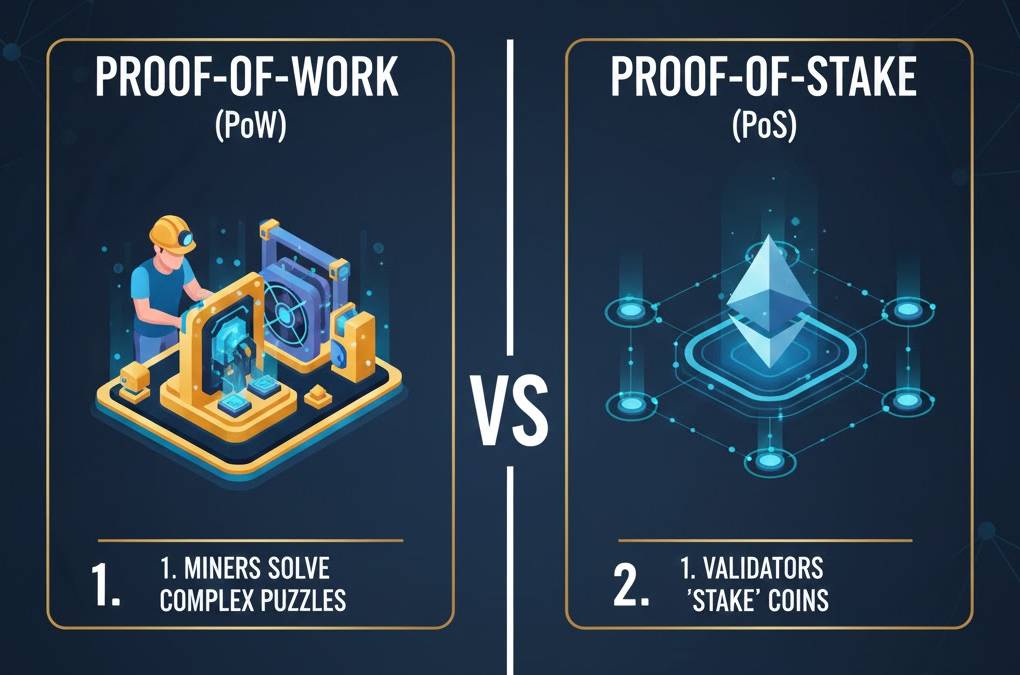
In Proof of Work, miners compete to solve complex mathematical puzzles. The first miner to solve the puzzle gets to add a block of transactions to the blockchain and receives cryptocurrency rewards. To add fraudulent transactions, an attacker would need to solve puzzles faster than the entire rest of the network combined—economically impractical with Bitcoin's network size.
Mining Process
Miners collect pending transactions into a block. They then repeatedly hash the block's data with different random numbers until finding a hash that meets specific criteria (starts with certain number of zeros). On average, finding this hash takes the network approximately 10 minutes (for Bitcoin). The first miner to find it broadcasts the block and receives rewards.
Mining Difficulty Adjustment
If more miners join and blocks are found faster than 10 minutes, the puzzle difficulty automatically increases. If miners leave, difficulty decreases. This mechanism maintains consistent block times regardless of network hash rate. Difficulty adjusts approximately every two weeks (every 2,016 blocks for Bitcoin).
Mining Rewards
Miners receive block rewards (newly created cryptocurrency) and transaction fees. Block rewards started at 50 Bitcoin per block but halve every 4 years. Currently, Bitcoin miners receive 6.25 Bitcoin per block plus transaction fees. As rewards decline, transaction fees become proportionally more important for miner incentives.
Energy Consumption
Proof of Work requires significant computational power, consuming substantial electricity. Bitcoin mining uses approximately 100+ terawatt-hours annually—comparable to entire countries' energy consumption. This is both a weakness (environmental concerns) and a feature (makes attacks prohibitively expensive).
Hardware Requirements
Mining requires specialized hardware. Early Bitcoin miners used CPUs, then GPUs, now specialized ASIC chips (Application-Specific Integrated Circuits). These chips cost millions for large operations. High hardware costs create barriers to entry, concentrating mining power among large operations. ASIC manufacturers benefit from this concentration.
Geographic Concentration
Mining concentrates in regions with cheap electricity (Iceland, China, Texas). Large mining farms operate at massive scale. This geographic concentration creates concerns about centralization—if a few mining pools in one country control network majority, they could theoretically attack the network. However, mining incentives prevent this.
Advantages of Proof of Work
- Proven secure with longest track record (Bitcoin since 2009)
- Extremely difficult to attack due to computational barriers
- Transparent—anyone can verify work was done
- Decentralized—mining can occur anywhere with electricity
- Economic security—miners must spend resources
Disadvantages of Proof of Work
- Massive energy consumption creating environmental concerns
- Expensive hardware creates barriers to participation
- Scalability limited—Bitcoin can handle ~7 transactions/second
- Mining centralization toward few pools and regions
- Slow transaction confirmation times
Proof of Stake Explained
How Proof of Stake Works
In Proof of Stake, validators are chosen based on the cryptocurrency they hold and "stake" (lock up) on the network. Validators with more stake have higher probability of being chosen to validate blocks. If validators act maliciously (approving fraudulent transactions), they lose their staked cryptocurrency—a financial penalty that deters misconduct.
Validator Selection
Validators are randomly selected weighted by stake size. If you stake 1% of all staked cryptocurrency, you have ~1% chance of being chosen to validate the next block. Some systems use additional factors like how long you've staked. Randomization prevents predictability and centralization.
Staking Requirements
Different Proof of Stake systems have different minimum stakes. Ethereum requires 32 ETH (~$60,000+ at current prices) to run a validator node. Some systems allow smaller stakes. Higher stakes increase hardware and operational requirements, potentially centralizing power among wealthy holders.
Rewards and Penalties
Validators earn staking rewards for honest participation, typically 5-15% annually depending on network. Rewards come from transaction fees and newly created cryptocurrency. For malicious behavior, validators lose staked cryptocurrency—called "slashing." The fear of slashing incentivizes honest behavior.
Slashing and Security
If validators approve conflicting blocks or other rule violations, they're "slashed"—losing a portion of staked cryptocurrency. Massive slashing (losing 100% of stake) deters organized attacks. Smaller slashing for simple mistakes prevents trivial errors. This financial incentive replaces computational proof with economic proof.
Energy Efficiency
Proof of Stake requires minimal computational resources. Validators can run on standard computers. Ethereum's energy consumption decreased by ~99.95% after switching from Proof of Work to Proof of Stake. This is a major environmental advantage over Proof of Work.
Scalability Advantages
Proof of Stake enables faster block times and higher transaction throughput. Bitcoin's Proof of Work creates ~10 minute blocks, limiting transactions. Proof of Stake networks like Ethereum can process blocks in seconds, dramatically increasing scalability. Reduced block times improve user experience.
Advantages of Proof of Stake
- Minimal energy consumption (99%+ less than Proof of Work)
- Low barriers to entry for validators
- High scalability—faster blocks and more transactions per second
- Incentive-aligned—validators lose stake for misconduct
- Lower hardware requirements for participation
Disadvantages of Proof of Stake
- Less proven—Ethereum Proof of Stake only since 2022
- Rich-get-richer dynamics—large stakes earn more
- Potentially more centralized—high stakes concentrate in few hands
- Complexity—harder to understand than Proof of Work
- Slashing attacks theoretically possible (though not yet observed)
Security Comparison
Proof of Work Security Model
Proof of Work security relies on computational work. To attack the network, an attacker must control 51%+ of network mining power and execute the attack before honest miners complete more blocks. The cost is astronomical—for Bitcoin, controlling 51% would require billions in hardware and electricity.
Proof of Stake Security Model
Proof of Stake security relies on economic incentives. To attack the network, an attacker must acquire 51%+ of staked cryptocurrency, then lose it all through slashing if caught. The cost is also high—acquiring 51% of all staked Ethereum would cost billions. However, no physical hardware cost, only capital.
Nothing at Stake Attack
A theoretical Proof of Stake vulnerability: validators could validate conflicting chains without penalty if they stake on multiple chains simultaneously. Modern Proof of Stake systems address this through cryptographic penalties—validators are slashed for signing conflicting blocks regardless of outcome. Ethereum uses this approach.
51% Attack Probability
For Proof of Work, acquiring and operating 51% of mining power is logistically complex and potentially detectable. For Proof of Stake, acquiring 51% of staked coins is economically challenging but logistically simple. Both are expensive enough that attacks are rational economically.
Security Longevity
Proof of Work's security diminishes if mining profitability declines. As block rewards decrease, miners might quit if transaction fees don't compensate. Proof of Stake's security remains high as long as staking yields attract capital. Both have different long-term sustainability questions.
Decentralization Comparison
Mining Centralization
Proof of Work mining concentrates in mining pools—entities that aggregate many miners' work. The top few pools control majority of Bitcoin's hash rate. Large mining operations dominate due to hardware costs. However, miners can switch pools if they act maliciously, preventing absolute control.
Staking Centralization
Proof of Stake enables validators without mining pools, but high hardware and capital requirements create barriers. Wealthy entities and institutions can stake easily. Staking services like Lido allow delegating stake, centralizing actual control despite distributed participation. Concentration depends on system design.
Wealth Concentration Impact
In Proof of Work, wealthy entities can own more hardware but not earn proportionally more—diminishing returns from scale. In Proof of Stake, wealthy entities earn more because larger stakes generate higher rewards. Proof of Stake potentially amplifies wealth inequality more than Proof of Work.
Geographic Decentralization
Proof of Work mining concentrates geographically in cheap-electricity areas. Proof of Stake allows global participation from anywhere with internet. Geographic diversity may be higher in Proof of Stake, though both have centralization pressures.
Environmental Impact
Energy Consumption Comparison
Bitcoin's Proof of Work consumes ~100+ TWh annually. Ethereum's Proof of Stake consumes ~0.05 TWh annually—roughly 2,000x less. This massive difference is environmentally significant. Bitcoin's energy consumption roughly equals Argentina's total electricity consumption, while Ethereum's is negligible.
Carbon Footprint
Bitcoin's carbon footprint is significant, estimated at 50+ million tons of CO2 annually—comparable to countries like Austria. Ethereum's footprint is negligible. As renewable energy adoption increases, both blockchains' footprints decline. However, Proof of Work's inherent energy requirements are irreducible.
Environmental Impact of Hardware Manufacturing
Proof of Work requires manufacturing millions of specialized ASICs annually. Manufacturing electronics creates environmental impact from mining, smelting, and shipping. Proof of Stake requires standard computers, reducing manufacturing impact. This is another environmental advantage for Proof of Stake.
Environmental Concerns and Investment
Environmental concerns have caused some organizations to avoid Bitcoin investment. Ethereum's switch to Proof of Stake was partially motivated by environmental pressure. As environmental consciousness increases, energy-efficient consensus mechanisms like Proof of Stake gain advantages in attracting investment and adoption.
Scalability Comparison
Transaction Throughput
Bitcoin (Proof of Work) handles approximately 7 transactions per second. Ethereum (Proof of Stake) handles approximately 15 transactions per second on layer 1, though both use layer 2 solutions for scaling. Visa handles ~65,000 tps. Blockchain scalability remains a challenge for both mechanisms.
Block Time and Confirmation
Bitcoin blocks occur every ~10 minutes. Users typically wait for 6 confirmations (1 hour) before considering transactions final. Ethereum Proof of Stake blocks occur every ~12 seconds with finality in ~2 minutes. Faster blocks improve user experience significantly.
Layer 2 Scaling Solutions
Both blockchains use layer 2 solutions (Lightning Network for Bitcoin, Polygon/Arbitrum for Ethereum) that handle transactions off-chain while settling periodically on-chain. Layer 2 solutions achieve thousands of transactions per second. Layer 2 scalability applies equally to both mechanisms.
Future Scalability Plans
Bitcoin plans for layer 2 expansion. Ethereum is developing sharding—dividing the blockchain into parallel chains. Both mechanisms can achieve high scalability through technical upgrades. Proof of Stake potentially enables easier scaling because faster blocks are feasible.
Conclusion
Proof of Work and Proof of Stake are both valid consensus mechanisms with different trade-offs. Proof of Work is proven, secure, and truly decentralized through physical distribution of mining hardware. However, it consumes enormous energy and faces scalability limits. Proof of Stake is energy-efficient, scalable, and achieves consensus through economic incentives. However, it has less historical track record and potentially enables wealth concentration.
Both mechanisms can secure valuable cryptocurrencies. Bitcoin's Proof of Work has proven secure for 15+ years. Ethereum's Proof of Stake has proven secure since 2022. Neither mechanism is objectively superior—they represent different design philosophies and trade-offs suited to different goals and priorities.