Bitcoin Halving Explained: Impact on Price, Mining, and Investors
Understand Bitcoin halving: How the protocol reduces block rewards, what it means for Bitcoin price, miners, and investors. Complete technical explanation.
Bitcoin Halving Explained: Complete Guide
Bitcoin halving is one of the most significant events in cryptocurrency history, occurring roughly every four years. Understanding how it works, why it exists, and how it affects Bitcoin's price, miners, and investment strategy is essential for anyone involved in crypto. This comprehensive guide explains everything you need to know.
What Is Bitcoin Halving?
The Basic Concept
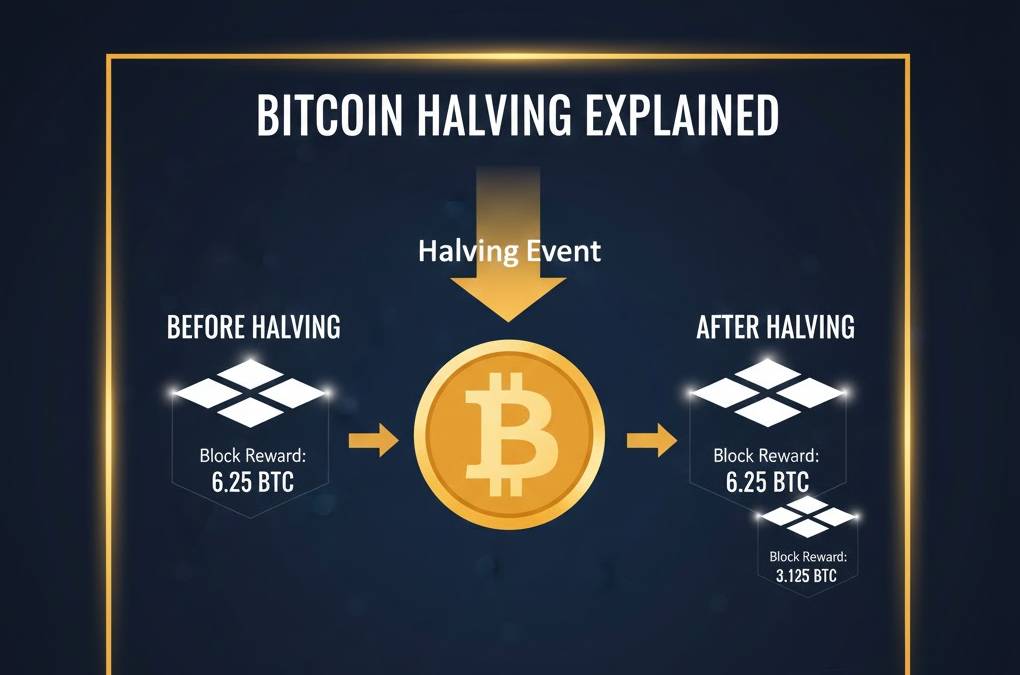
Bitcoin halving is a programmatic reduction of the amount of new Bitcoin created and distributed to miners approximately every four years. During halving, the block reward—the payment miners receive for solving complex mathematical puzzles—is cut in half.
When Bitcoin launched in January 2009, miners received 50 BTC for each block successfully mined. Every 210,000 blocks (approximately four years), the protocol automatically reduces this reward by 50%:
- 2009-2012: Block reward = 50 BTC (first era)
- 2012-2016: Block reward = 25 BTC (first halving, November 2012)
- 2016-2020: Block reward = 12.5 BTC (second halving, July 2016)
- 2020-2024: Block reward = 6.25 BTC (third halving, May 2020)
- 2024-2028: Block reward = 3.125 BTC (fourth halving, April 2024)
This pattern continues until around 2140 when the block reward becomes negligible. At that point, Bitcoin will reach its maximum supply of 21 million coins.
Why Is It Called Halving?
The term literally describes what happens: the reward is cut in half. This is a deliberate design feature built into Bitcoin's code when Satoshi Nakamoto created the protocol. Unlike fiat currencies that governments can print infinitely, Bitcoin has a predetermined, mathematically scarce supply.
When Will Future Halvings Occur?
Halvings are triggered by block numbers, not time. Bitcoin's network aims for 10-minute average block time, meaning approximately 6 blocks per hour, 144 per day, and 52,560 per year.
At 210,000 blocks per halving, this equals:
| Halving | Date | Block Reward | Estimated Year |
|---|---|---|---|
| First | November 2012 | 50 → 25 BTC | 2012 |
| Second | July 2016 | 25 → 12.5 BTC | 2016 |
| Third | May 2020 | 12.5 → 6.25 BTC | 2020 |
| Fourth | April 2024 | 6.25 → 3.125 BTC | 2024 |
| Fifth | Estimated | 3.125 → 1.5625 BTC | 2028 |
Why Halving Exists: Bitcoin's Monetary Policy
The Philosophy Behind Halving
Satoshi Nakamoto designed Bitcoin as "digital gold"—a scarce asset with known supply limitations. Gold is valuable partly because it's geologically scarce. Bitcoin is programmatically scarce.
This contrasts sharply with fiat currencies like the US Dollar. Central banks can print unlimited dollars, creating inflation. Bitcoin's maximum supply of 21 million is immutable—hardcoded into the protocol and can't be changed without consensus from the entire Bitcoin community.
Creating Scarcity Over Time
Halving implements a decreasing inflation rate. Bitcoin's supply grows over time but at a declining pace:
- Year 1-4: Supply growing at ~4.2% annually (50 BTC reward, no previously mined coins)
- Year 5-8: Supply growing at ~2.1% annually (25 BTC reward)
- Year 9-12: Supply growing at ~1.05% annually (12.5 BTC reward)
- Long-term: Supply approaching 21 million, growth rate approaching 0%
This declining inflation model is fundamentally different from both government currency (which has no limit) and commodities like gold (where new supply depends on mining economics, not protocol rules).
The Distribution of Early Bitcoin
Halving also ensures a fair distribution of Bitcoin rewards over time. Early miners, despite greater difficulty, receive higher block rewards. This incentivizes Bitcoin adoption when risks were highest. Later miners receive smaller rewards but Bitcoin is more valuable, potentially offsetting the lower block reward.
Impact on Bitcoin Supply and Inflation
How Halving Reduces Inflation
Inflation represents the rate at which the supply of a currency increases. Bitcoin's inflation rate is fully transparent and predictable:
Before the fourth halving (2024):
- Block reward: 6.25 BTC
- Blocks per year: ~52,560
- Annual new supply: ~328,500 BTC
- Existing supply: ~21 million BTC (approaching)
- Inflation rate: ~1.6% annually
After the fourth halving (April 2024):
- Block reward: 3.125 BTC
- Annual new supply: ~164,250 BTC
- Inflation rate: ~0.8% annually
For comparison, the Federal Reserve targets 2% inflation for the US Dollar. Bitcoin's inflation is now lower than the US Dollar, making it potentially a better store of value for long-term holding.
Approaching 21 Million
As halving continues, Bitcoin's supply asymptotically approaches 21 million BTC. Approximately 21 million BTC will be mined by 2140, after which virtually no new supply enters circulation. The final few Bitcoin will take until 2140 to completely mine because halvings continue indefinitely (the reward never hits zero, just becomes infinitesimally small).
The practical result: By 2045 or so, over 99% of Bitcoin will be mined. From then until 2140, new Bitcoin supply is negligible, making Bitcoin functionally non-inflationary.
Impact on Bitcoin Miners
Profitability Effects
Halving directly affects miner profitability. A miner earning 6.25 BTC per block suddenly earns 3.125 BTC—a 50% income reduction overnight. Without offsetting factors, this would halve mining profitability.
However, mining profitability depends on multiple variables:
Profitability = (Block Reward × Bitcoin Price) / Operational Costs
The block reward is cut in half, but Bitcoin price and operational costs can change dramatically. Historical pattern:
- Pre-halving: Miners anticipate reduced rewards, so those unable to handle lower profitability exit the network
- Post-halving: Network difficulty decreases (fewer miners means less difficulty adjustment)
- Bull market following: Bitcoin price typically appreciates 6-12 months post-halving, compensating miners
Mining Difficulty Adjustments
Bitcoin's difficulty adjusts every 2,016 blocks (~2 weeks) to maintain 10-minute average block time. When miners leave post-halving (because reduced rewards make mining uneconomical), difficulty decreases, making remaining miners more profitable. This creates an equilibrium:
- Halving reduces block rewards
- Some miners exit (no longer profitable)
- Difficulty decreases
- Remaining miners become more profitable
- Equilibrium reached where marginal miners break even
Historical Miner Response
Examining past halvings:
First Halving (2012):
- Difficulty decreased 15% post-halving
- Bitcoin price increased from $6 to $1,000 within a year
- Mining remained highly profitable
Second Halving (2016):
- Difficulty decreased 20% post-halving
- Bitcoin price increased from $650 to $20,000 within a year
- Mining profitability surged
Third Halving (2020):
- Difficulty decreased 15% post-halving
- Bitcoin price increased from $9,000 to $69,000 within 16 months
- Mining was extremely profitable in the bull market
Fourth Halving (2024):
- Expected similar patterns (difficulty adjustment, potential price appreciation)
Long-Term Mining Viability
As block rewards shrink toward zero, mining profitability will eventually depend on transaction fees rather than block rewards. Bitcoin's fee market will need to mature to support mining after block rewards become negligible. Some analysts worry that future halvings might make Bitcoin security unsustainable, though this is disputed.
Historical Impact on Bitcoin Price
The Halving Bull Market Hypothesis
Bitcoin has experienced remarkable price appreciation in the months and years following each halving. This creates a popular theory: halving causes bull markets. However, the relationship is more complex than simple cause-and-effect.
Examining Price Patterns
Before First Halving (June 2012):
- Bitcoin price: ~$6
After First Halving (December 2012):
- Bitcoin price: ~$13 (2x in 6 months)
After First Halving (December 2013):
- Bitcoin price: ~$1,000 (150x in 1 year) - though this was partly a speculative bubble
Before Second Halving (July 2016):
- Bitcoin price: ~$650
After Second Halving (December 2016):
- Bitcoin price: ~$950 (1.5x in 6 months)
After Second Halving (December 2017):
- Bitcoin price: ~$13,000 (20x in 1 year) - another speculative peak
Before Third Halving (May 2020):
- Bitcoin price: ~$9,500
After Third Halving (December 2020):
- Bitcoin price: ~$29,000 (3x in 6 months)
After Third Halving (November 2021):
- Bitcoin price: ~$69,000 (7x in 1.5 years)
Why Does Halving Correlate with Bull Markets?
Several factors may explain halving-bull market correlation:
- Supply Reduction: Decreased new supply can support higher prices (supply-demand dynamics)
- Market Attention: Halving events generate media coverage, attracting new investors
- Scarcity Narrative: Halving reinforces Bitcoin's scarcity story, appealing to long-term investors
- Liquidity Cycles: Halvings often align with broader crypto market cycles independent of halving itself
- Self-Fulfilling Prophecy: Traders buy before halving expecting price increases, creating the increase
Important Caveats
Halving doesn't guarantee price appreciation. Bitcoin crashed 50% within 3 months of the second halving (July 2016) before rallying later. Bull markets have also occurred without halving events. Halving is a factor but not the sole determinant of Bitcoin price.
Halving and Investor Strategy
Halving as an Investment Signal
Some investors time Bitcoin purchases around halving events, expecting post-halving bull markets. Strategies include:
- Pre-Halving Accumulation: Buy before halving expecting price increase
- Dollar-Cost Averaging: Buy consistently regardless of halving, ignoring the event
- Contrarian Strategy: Buy when price drops before halving (during bear markets), avoiding the hype
Historical returns favor consistent dollar-cost averaging over trying to time halving events. However, some traders successfully profit from halving hype.
Long-Term Implications
For long-term investors, halving reduces inflation and reinforces Bitcoin's scarcity narrative. The smaller the annual new supply, the more valuable existing Bitcoin potentially becomes. Over decades, this contributes to Bitcoin's long-term value proposition.
Halving and Market Cycles
Bitcoin typically experiences 4-year cycles loosely aligned with halving events:
- Year 0 (Halving Year): Price often ranges widely
- Year 1-2 (Post-Halving): Bull market often begins
- Year 3 (Approaching Next Halving): Bull market peaks, bear market begins
- Year 4-0 (Post-Peak): Bear market continues until next halving
This cycle is not guaranteed—the 2024 halving is being studied to see if this pattern holds amid changed market conditions (Bitcoin ETFs, institutional adoption, different macroeconomic backdrop).
Technical Details and Implementation
How the Halving Is Hardcoded
Bitcoin's halving is implemented via this simple logic in the code:
Block subsidy = 50 BTC >> (height / 210,000)
The ">>" represents a bitwise right-shift operation (dividing by 2 each time). This formula automatically reduces the reward by half every 210,000 blocks. There's no committee vote, no central authority decision—the protocol enforces it mathematically.
Why 210,000 Blocks?
Satoshi chose 210,000 blocks (~4 years at 10-minute block time) to create a predictable cycle. Four years provided reasonable periods between halvings—long enough for Bitcoin to mature between each event, short enough to create measurable supply reduction.
The Final Halving
Eventually, after approximately 64 halvings (around 2140), the block reward approaches zero (becomes a satoshi—Bitcoin's smallest unit). At this point, miners depend entirely on transaction fees. The network's security model transitions from inflation-based incentives to fee-based incentives.
Halving and Regulatory Environment
Is Halving an Event of Regulatory Concern?
Halving events typically don't trigger regulatory responses. Governments and regulators generally don't interfere with Bitcoin's technical operations. However, halving-related market volatility has occasionally prompted regulatory attention.
Mining Regulation
Halving affects mining profitability, which can impact mining regulation. Some jurisdictions encourage Bitcoin mining (Iceland, El Salvador) while others discourage it (China banned it). Halving-induced profitability changes may influence which regions see mining activity shifts.
The Next Halving and Future Outlook
Fifth Halving (Estimated 2028)
The next halving is expected around mid-2028, reducing block rewards from 3.125 BTC to 1.5625 BTC. Using the halving schedule, approximately 97% of Bitcoin will be mined by that point (20.4M of 21M BTC).
Remaining Halvings
Subsequent halvings will continue approximately every four years until 2140-2145 when block rewards become negligible. By then, Bitcoin's fixed supply of 21 million will be complete.
Security Considerations
As block rewards shrink, transaction fees must increase to maintain mining security. Bitcoin's fee market will become increasingly important. This evolution from inflationary to fee-based incentives is crucial for long-term network security.
Conclusion
Bitcoin halving is a revolutionary feature—a programmatic monetary policy built into the protocol itself. Every four years, the rate at which new Bitcoin enters circulation is reduced by half. This creates a predictable, transparent inflation schedule fundamentally different from government currencies.
Historically, halvings have correlated with bull markets and significant price appreciation, though the relationship is complex and not guaranteed. For miners, halving reduces immediate profitability but creates opportunities when prices rise. For investors, halving reinforces Bitcoin's scarcity narrative and may influence long-term value.
Understanding halving provides crucial context for understanding Bitcoin's monetary policy, supply dynamics, and historical price patterns. Whether you're a long-term investor, trader, or miner, halving events deserve careful attention as significant milestones in Bitcoin's evolution toward a fully mined, non-inflationary global monetary network.