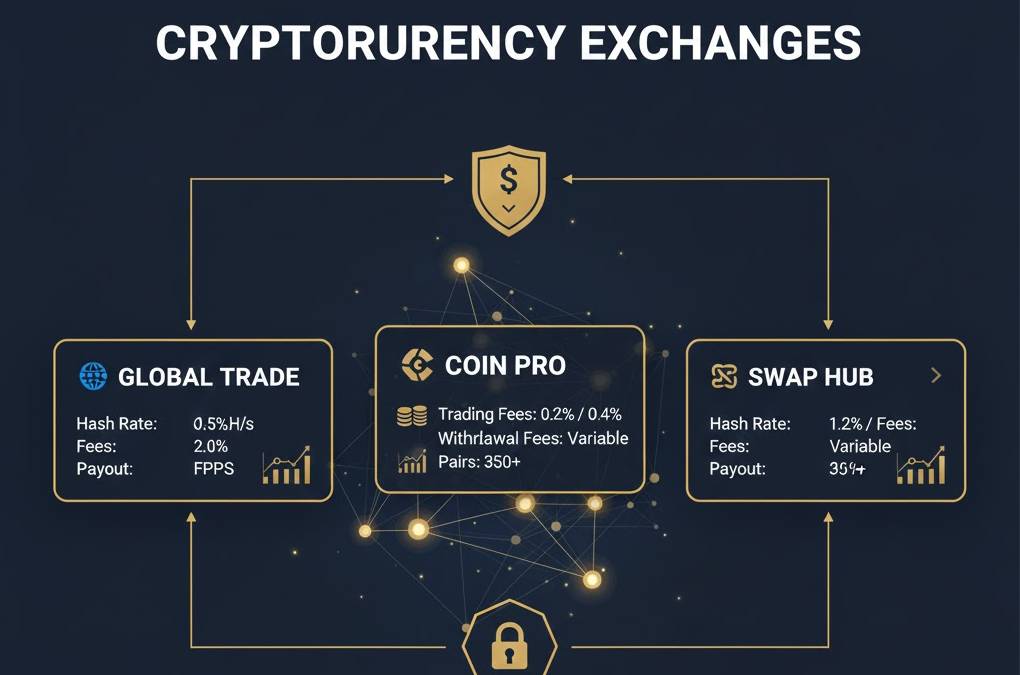
Cryptocurrency Exchanges: Choosing the Right Platform
Complete guide to cryptocurrency exchanges: centralized vs decentralized, major platforms, trading features, fees, security, regulation, and how to choose the right exchange for your needs.
Cryptocurrency Exchanges: Comparison & Security Guide
A cryptocurrency exchange is where you buy, sell, and trade digital assets. This comprehensive guide explores centralized and decentralized exchanges, major platforms, fees, security considerations, and regulations affecting the industry.
What Is a Cryptocurrency Exchange?
A cryptocurrency exchange is a platform where you can buy, sell, and trade cryptocurrencies for other digital assets or traditional currencies. Exchanges serve as the primary entry point for most people getting into cryptocurrencies. They facilitate price discovery through market mechanisms and provide the liquidity necessary for efficient trading.
Think of a cryptocurrency exchange like a traditional stock exchange, but for digital assets. Instead of buying shares in companies, you're buying cryptocurrencies like Bitcoin and Ethereum. Exchanges provide order matching, meaning they connect buyers and sellers and facilitate the transaction.
Centralized Exchanges (CEX)
Centralized exchanges are platforms operated by a company that acts as an intermediary between buyers and sellers. They maintain order books, hold user funds in custody, and manage the trading process. The most popular centralized exchanges include Coinbase, Kraken, Binance, and FTX.
How Centralized Exchanges Work
When you use a centralized exchange, you deposit your funds into an account controlled by the exchange. The exchange then holds your money and allows you to place buy and sell orders. When you place a buy order for Bitcoin, the exchange finds matching sell orders and executes the trade. Your cryptocurrency is then held in your exchange account (in their custody) rather than your personal wallet.
Advantages of Centralized Exchanges
- Ease of Use: Centralized exchanges are designed for simplicity. Beginners can quickly open an account and start trading without technical knowledge.
- Fiat On-Ramps: They allow you to deposit traditional currencies (USD, EUR, etc.) via bank transfer, credit card, or other methods, making it easy to enter the cryptocurrency market.
- High Liquidity: Large centralized exchanges have massive trading volumes, meaning you can quickly buy or sell large amounts of cryptocurrency at fair prices.
- Customer Support: Established exchanges offer customer support for account issues and technical problems.
- Regulation: Many centralized exchanges operate under regulatory frameworks, providing some protection to users.
- Security Features: Reputable exchanges implement security measures like two-factor authentication, cold storage of funds, and insurance programs.
Disadvantages of Centralized Exchanges
- Custody Risk: The exchange controls your private keys and holds your funds. If the exchange is hacked or goes bankrupt, you could lose your money.
- KYC Requirements: Centralized exchanges require identity verification (Know Your Customer), compromising your privacy.
- Account Freezes: Exchanges can freeze accounts, restrict withdrawals, or limit trading if they suspect fraud or regulatory violations.
- Limited Control: You don't own the private keys to your funds, meaning you don't have true custody.
- Counterparty Risk: You depend on the exchange's solvency and honesty.
Popular Centralized Exchanges
Coinbase: The largest cryptocurrency exchange in the United States, known for user-friendly interface, strong regulation compliance, and educational resources. It's ideal for beginners.
Binance: The world's largest cryptocurrency exchange by trading volume. It offers hundreds of cryptocurrencies, low fees, and advanced trading features. Binance operates globally though regulatory challenges affect different regions.
Kraken: A well-established exchange focusing on security and regulatory compliance. It's popular among European users and offers good customer support.
Gemini: Founded by the Winklevoss twins, Gemini emphasizes security and regulatory compliance. It's available primarily in the United States.
FTX (formerly): Was a major exchange until it collapsed spectacularly in 2022, highlighting the risks of exchange failures and the importance of choosing reputable platforms.
Decentralized Exchanges (DEX)
Decentralized exchanges are protocols that operate on blockchain networks without a central operator. Users trade directly with each other using smart contracts. Popular DEXs include Uniswap, SushiSwap, PancakeSwap, and Curve Finance.
How Decentralized Exchanges Work
Rather than using order books like centralized exchanges, most decentralized exchanges use an automated market maker (AMM) model. Users provide liquidity by depositing pairs of tokens into smart contract pools. When you trade, you're actually swapping your tokens for tokens in a liquidity pool, with prices determined by the pool's ratio of tokens.
The transaction is executed directly on the blockchain, and you maintain custody of your private keys throughout the process. Your wallet connects to the DEX interface, and you approve transactions directly from your wallet.
Advantages of Decentralized Exchanges
- Non-Custodial: You maintain control of your private keys. The DEX never holds your funds.
- Privacy: Most DEXs don't require identity verification, allowing pseudonymous trading.
- No Account Freezes: Your funds can't be frozen or restricted by an exchange operator.
- Access to New Tokens: DEXs allow trading of newer and smaller tokens that may not be listed on centralized exchanges.
- Censorship Resistant: Operating on decentralized blockchains, DEXs are resistant to censorship and government control.
- Financial Sovereignty: You have true ownership and control of your assets.
Disadvantages of Decentralized Exchanges
- Higher Complexity: DEXs require more technical knowledge. You need to understand wallets, slippage, gas fees, and blockchain interactions.
- Lower Liquidity: Most DEXs have lower trading volumes than centralized exchanges, resulting in wider price spreads and higher slippage.
- Higher Fees: Blockchain network fees (gas fees) can be expensive, especially on networks like Ethereum during periods of congestion.
- Slower Transactions: Transactions on DEXs depend on blockchain confirmation times, which can range from seconds to minutes.
- Smart Contract Risk: DEXs depend on smart contract code, and bugs or vulnerabilities could result in lost funds.
- No Customer Support: If something goes wrong, there's no company to appeal to for help.
- No Fiat On-Ramps: Most DEXs don't allow direct deposits of traditional currencies, requiring you to already own cryptocurrency.
Popular Decentralized Exchanges
Uniswap: The largest DEX by trading volume, operating on Ethereum and other blockchains. It uses an AMM model and is known for reliability and a large selection of tokens.
PancakeSwap: A DEX on the Binance Smart Chain offering lower fees than Ethereum-based DEXs.
Curve Finance: Specialized DEX optimized for stablecoin trading with minimal slippage.
SushiSwap: A DEX fork of Uniswap with some additional features and incentive mechanisms.
CEX vs DEX: Key Differences
Here's a comparison of centralized and decentralized exchanges:
| Feature | Centralized (CEX) | Decentralized (DEX) |
|---|---|---|
| Custody | Exchange holds funds | You maintain control |
| Privacy | KYC required | Anonymous |
| Ease of Use | Very simple | Requires technical knowledge |
| Liquidity | High | Variable, often lower |
| Trading Speed | Instant | Blockchain dependent |
| Token Selection | Limited to listed tokens | Access to any token |
| Account Risk | Can be frozen | No account to freeze |
| Fiat On-Ramp | Yes | No |
Understanding Trading Pairs and Markets
On cryptocurrency exchanges, you trade in pairs. The most common pair is BTC/USD, meaning you're trading Bitcoin for U.S. dollars. The first currency in the pair (BTC) is called the base, and the second (USD) is the quote currency.
Major trading pairs include BTC/USD, ETH/USD, and others involving major cryptocurrencies. Most exchanges also offer trading pairs between cryptocurrencies, like BTC/ETH, allowing you to exchange one cryptocurrency for another without converting to fiat currency.
Trading pairs determine the markets available on an exchange. An exchange with more trading pairs offers more flexibility but may be more complex to navigate.
Exchange Fees and Costs
Different exchanges charge different fees, which can significantly impact your profitability, especially for frequent traders.
Trading Fees
Trading fees (also called taker and maker fees) are charged each time you buy or sell. Maker fees apply when your order is added to the order book and filled later. Taker fees apply when your order is immediately matched with an existing order.
On centralized exchanges, trading fees typically range from 0.01% to 0.5% per trade, depending on your trading volume. High-volume traders often get reduced fees.
On decentralized exchanges, there's no explicit trading fee from the exchange, but you pay network gas fees to process transactions on the blockchain.
Withdrawal Fees
Centralized exchanges often charge fees to withdraw cryptocurrencies from your account to your personal wallet. These fees vary by cryptocurrency and exchange.
Deposit Fees
Some exchanges charge fees for deposits, particularly when depositing traditional currency via credit card or bank transfer.
Network Fees
When you withdraw cryptocurrency from an exchange, the exchange pays the blockchain network fee to process the transaction. Some exchanges cover this cost, while others pass it to users.
Security Considerations for Exchanges
Hacks and Breaches
Centralized exchanges are attractive targets for hackers because they hold large amounts of cryptocurrency in custody. Several major exchange hacks have occurred historically, including the Mt. Gox collapse in 2014 and the Binance hack in 2019.
To protect yourself, choose exchanges with strong security records, multi-signature wallet security, and insurance programs. Never keep more cryptocurrency on an exchange than you plan to trade with soon.
Two-Factor Authentication (2FA)
Always enable two-factor authentication on your exchange account. Use an authenticator app like Google Authenticator or Authy rather than SMS authentication, which is vulnerable to SIM swapping attacks.
Withdrawal Whitelisting
Many exchanges allow you to whitelist withdrawal addresses. Once whitelisted, funds can only be withdrawn to those addresses. This prevents an attacker from withdrawing your funds to their address even if they gain access to your account.
Insurance and Guarantees
Some centralized exchanges offer insurance programs or customer protection guarantees. Coinbase, for example, insures cryptocurrency holdings in digital vaults against hacking and theft. Review an exchange's security policies before using it.
Smart Contract Risks for DEXs
Decentralized exchanges rely on smart contracts, which can have vulnerabilities. Before trading on a DEX, verify that the smart contract has been audited by reputable security firms.
Regulation of Cryptocurrency Exchanges
Cryptocurrency exchange regulation is evolving rapidly and varies significantly by jurisdiction.
United States
In the U.S., cryptocurrency exchanges are regulated as Money Services Businesses. They must register with FinCEN (Financial Crimes Enforcement Network) and comply with state money transmitter regulations. Exchanges must implement know-your-customer (KYC) and anti-money-laundering (AML) procedures.
European Union
The EU's Markets in Crypto-Assets Regulation (MiCA) establishes comprehensive regulation for cryptocurrency service providers, including exchanges. Exchanges must obtain regulatory licenses and meet capital and operational requirements.
Other Jurisdictions
Regulation varies by country. Some countries have embraced cryptocurrency and established clear regulatory frameworks, while others have restricted or banned cryptocurrency exchanges entirely.
Implications for Users
Regulatory compliance increases operational costs for exchanges, which often translates to higher fees. However, regulation also provides investor protection, making regulated exchanges generally safer than unregulated ones.
Choosing a Cryptocurrency Exchange
For Beginners
Start with a well-established, regulated centralized exchange like Coinbase or Kraken. These platforms are beginner-friendly, offer fiat on-ramps, and have strong security records. The slightly higher fees are worth the simplicity and peace of mind.
For Active Traders
More active traders might prefer Binance or FTX (before its collapse) for lower fees, more trading pairs, and advanced trading features like margin trading and futures. Ensure you understand the increased complexity and risks of advanced trading features.
For Privacy-Focused Users
If privacy is your priority, use decentralized exchanges. However, understand that you'll trade off convenience and liquidity for privacy. You might also consider using a centralized exchange to buy your initial cryptocurrency, then transfer it to a DEX.
For Low-Cost Traders
Consider exchanges with the lowest fee structures for your trading patterns. For frequent traders, Binance often has the lowest fees. For occasional traders, Coinbase Pro or Kraken might be more cost-effective.
For Maximum Security
Choose an exchange with a strong security track record, proven insurance programs, and regulatory compliance. Never keep more cryptocurrency on an exchange than you're actively trading. Transfer excess funds to a personal wallet.
How to Use an Exchange Safely
Start Small
Begin with small trades to familiarize yourself with the platform before making significant investments.
Secure Your Account
Use a strong, unique password and enable two-factor authentication immediately upon account creation.
Verify Addresses
When withdrawing cryptocurrency, carefully verify the destination address. Cryptocurrency transactions are irreversible.
Monitor Your Account
Regularly check your account for unauthorized activity. Set up email notifications for logins and withdrawals.
Don't Keep Everything on Exchange
Move cryptocurrency you're not actively trading to a secure personal wallet. This reduces your exposure if the exchange is compromised.
Update Your Software
Keep your computer and phone updated with security patches to protect against malware.
The Future of Cryptocurrency Exchanges
The exchange landscape continues to evolve with several emerging trends:
Institutional Adoption: More institutional investors are using cryptocurrency exchanges, driving higher trading volumes and more sophisticated trading features.
Regulation Expansion: As governments implement clearer regulations, the operating environment for exchanges is becoming more defined, though sometimes more restrictive.
DEX Growth: Decentralized exchanges continue to improve, with better user interfaces, lower fees through layer-2 solutions, and improved liquidity.
Hybrid Models: Some new platforms are developing hybrid approaches combining the simplicity and liquidity of centralized exchanges with the non-custodial features of decentralized exchanges.
Cryptocurrency Derivatives: Exchanges are offering more sophisticated products like options, futures, and perpetual contracts, allowing advanced trading strategies.
Conclusion
Cryptocurrency exchanges are essential infrastructure for the digital asset ecosystem, serving as the primary entry point for most users. Whether you choose a centralized or decentralized exchange depends on your priorities: centralized exchanges offer simplicity, liquidity, and fiat on-ramps, while decentralized exchanges provide privacy, non-custody of funds, and censorship resistance.
Beginners should start with established, regulated centralized exchanges like Coinbase or Kraken. As you gain experience, you can explore decentralized exchanges for specific trading opportunities. Regardless of which exchange you choose, prioritize security: enable two-factor authentication, use strong passwords, and never keep more cryptocurrency on an exchange than you're actively trading.
Remember that using an exchange is different from owning cryptocurrency. When your cryptocurrency is on an exchange, the exchange holds it in custody. For true financial sovereignty and security of larger holdings, transfer your cryptocurrency to a personal wallet where you control the private keys.
The cryptocurrency exchange market remains dynamic, with new platforms emerging and existing ones evolving. By understanding how exchanges work, comparing their features and fees, and implementing proper security practices, you can confidently participate in cryptocurrency trading and investing.