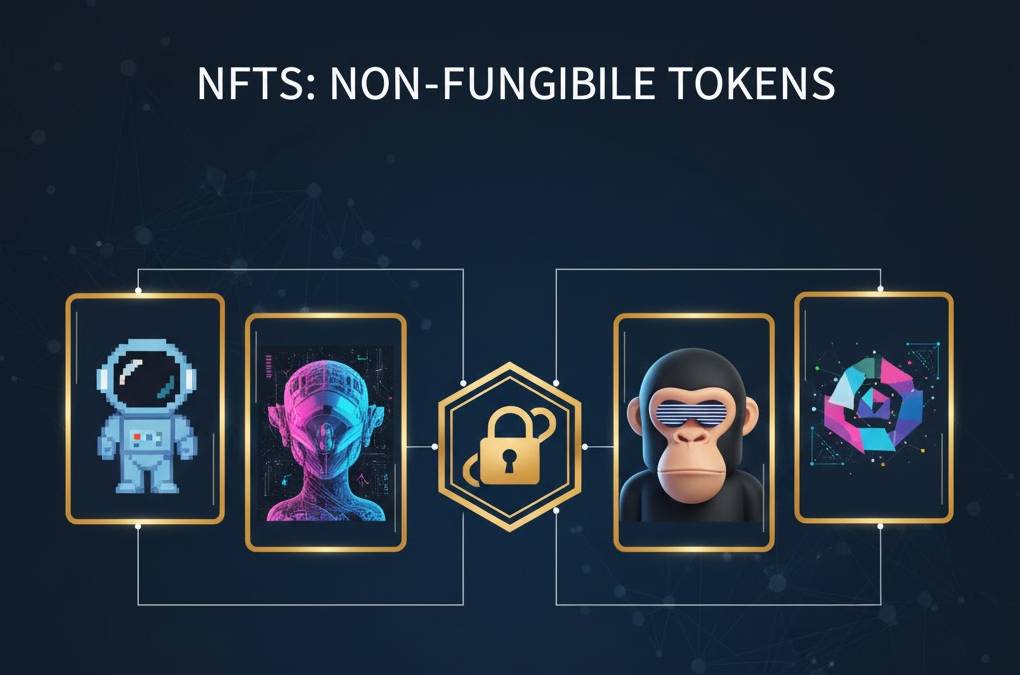
NFTs Explained: Understanding Non-Fungible Tokens

Non-Fungible Tokens (NFTs) represent ownership of unique digital or physical assets on a blockchain. Learn how NFTs work, their real-world applications, and whether they're worth investing in.

What Are Non-Fungible Tokens?

Non-Fungible Tokens, or NFTs, represent ownership of unique digital or physical assets on a blockchain. To understand NFTs, you first need to understand fungibility. A fungible asset is interchangeable—one unit equals another unit. A dollar bill is fungible; one $100 bill is worth exactly the same as any other $100 bill. Bitcoin is fungible; one Bitcoin equals any other Bitcoin. Non-fungible assets are unique and irreplaceable. A Picasso painting is non-fungible; no other painting equals it in value or characteristics. Your house is non-fungible; it has specific properties and location making it distinct from other houses. NFTs digitize this concept of uniqueness on the blockchain. An NFT is essentially a smart contract that certifies ownership of a specific digital or physical asset. This contract lives on a blockchain like Ethereum and contains metadata describing the asset. When you own an NFT, the blockchain permanently records that you own this specific, unique token.
## How NFTs Work ### Smart Contracts and Metadata NFTs are created using smart contracts following standards like ERC-721 (Ethereum's NFT standard) or ERC-1155 (semi-fungible tokens). The smart contract contains code defining the NFT's properties and rules governing its transfer. The actual asset—artwork, music, or document—isn't stored on the blockchain itself. Storing large files on blockchain would be prohibitively expensive and slow. Instead, the NFT contains metadata pointing to where the asset is stored, typically on platforms like IPFS (InterPlanetary File System) or centralized servers. The blockchain certifies ownership of this metadata and the reference to the asset. This certification is what creates the NFT's value. ### Minting and Ownership Creating an NFT is called "minting." The creator writes a smart contract specifying the NFT's properties and deploys it to a blockchain. This process costs a small fee (gas fee) and permanently records the NFT on the blockchain. Once minted, the NFT can be transferred to wallets. The blockchain maintains a permanent record of all ownership transfers, creating a complete provenance history. You can verify exactly who has owned the NFT since its creation. ### Verification and Authenticity The blockchain provides cryptographic proof of authenticity and ownership. Because blockchain records are immutable and distributed across thousands of independent computers, no one can forge NFT ownership or forge the transfer history. This is revolutionary for verifying authenticity of valuable items. An NFT certificate could verify that a physical artwork is authentic, making counterfeiting economically impossible. ## Types of NFTs ### Digital Art and Collectibles The most famous NFTs are digital artworks and collectibles. CryptoPunks, a series of 10,000 unique pixel-art characters, became valuable collectibles with some selling for millions. Bored Ape Yacht Club created similar success with cartoon ape characters. While many see this as speculative and pointless, digital art NFTs have created new opportunities for artists. They can reach global audiences instantly, receive royalties automatically through smart contracts, and build communities around their work. ### Gaming and In-Game Assets NFTs revolutionize gaming by allowing players to truly own in-game items. In traditional games, you pay for items that the game company controls and can remove. In NFT games, you own items as NFTs—no one can take them away. Axie Infinity created economic opportunities for players in developing countries who earned significant income by playing and trading NFT creatures. Players could own, trade, and breed digital pets with real economic value. ### Tickets and Events NFT tickets could eliminate ticket fraud while providing additional benefits. Event organizers could issue NFT tickets with automatic entry verification and built-in royalties, earning money whenever tickets resell. ### Real-World Assets NFTs can certify ownership of physical assets. A real estate NFT could represent house ownership. A luxury goods NFT could verify that a watch or handbag is authentic and original. Fractional NFTs allow dividing expensive assets into pieces. Instead of one person owning a $10 million artwork, thousands could own fractions and benefit from appreciation. ### Memberships and Credentials NFTs can represent memberships, credentials, and achievements. A professional license could be an NFT, providing instant verification without requiring background checks. Educational credentials could be NFTs, instantly verifiable by employers.
## Benefits of NFTs ### Ownership and Control NFTs give creators and owners complete control over their assets. Creators receive permanent credit and can program royalties into smart contracts, earning money whenever the NFT sells. Owners have genuine ownership, not temporary licenses. ### Programmable Royalties Smart contracts can automatically distribute royalties to creators whenever an NFT sells. An artist could receive 10% of every resale price forever. This changes artistic economics, creating ongoing income from work instead of one-time payments. ### Verification and Authenticity The blockchain creates immutable proof of authenticity and ownership history. For expensive items, this eliminates counterfeiting and provides complete provenance. ### Accessibility NFTs let artists monetize their work without gatekeepers. Musicians can sell directly to fans. Visual artists can reach global markets. This democratizes access to artistic distribution and funding. ### Interoperability An NFT created on one platform can be used on another. A gaming NFT created on Ethereum can potentially be used in multiple games that accept it. This interoperability creates more value than platform-specific items. ## Challenges and Criticisms ### Environmental Concerns Early NFT marketplaces used Ethereum, which at the time consumed enormous energy through Proof of Work consensus. NFTs minted during this period had significant environmental cost. However, Ethereum switched to Proof of Stake in 2022, reducing energy consumption by 99.95%. ### Bubbles and Speculation Much of the NFT enthusiasm has been speculative. Artists with minimal credibility sold meaningless token images for thousands. This bubble burst as hype faded and values crashed. Many NFT projects collapsed, leaving buyers with worthless tokens. ### Real-World Implementation Challenges While NFTs can theoretically represent real-world assets, legal systems haven't adapted to recognize blockchain ownership as definitive. A government might not recognize an NFT as proof of property ownership if existing law requires paper documentation. ### Environmental Skepticism Even with Ethereum's shift to Proof of Stake, some view NFTs as environmental irresponsibility. The energy consumed creating unnecessary digital assets could power homes. This criticism remains significant in environmentally conscious communities. ### Storage and Durability Issues NFTs reference assets stored off-chain, typically on IPFS or centralized servers. If the server hosting the asset shuts down, the reference breaks and the asset becomes inaccessible. The NFT persists, but it references nothing. ### Copyright and Rights Issues NFT creators can mint NFTs of content they don't own. Someone could take an artist's work and mint it as an NFT without permission. While smart contracts could address this through royalties, they can't prevent the initial infringement. ### Utility and Value Questions What makes an NFT valuable? For artworks where value is subjective, blockchain certification doesn't change the art's qualities. Many question whether NFT technology adds value beyond the art itself. ## NFT Standards and Platforms ### ERC-721 and ERC-1155 ERC-721 was the original NFT standard, ideal for creating unique tokens. ERC-1155 added flexibility, allowing single contracts to manage both fungible and non-fungible tokens, reducing complexity for collections. ### Leading Platforms **OpenSea**: The largest NFT marketplace for trading and minting various NFT types across multiple blockchains. **Rarible**: Community-driven marketplace enabling artists to create and sell NFTs with governance participation. **Foundation**: Artist-focused platform curating NFT drops and emphasizing direct creator-to-collector relationships. **Blur**: Newer marketplace emphasizing advanced features like lending and aggregation. ## The Current State and Future The NFT market has matured past the speculative bubble phase. Hype has diminished but genuine applications persist: - **Gaming** continues developing with improved game design and economics - **Digital art** created by established artists is gaining legitimacy - **Real-world asset** integration is advancing with legal frameworks developing - **Membership and credential** applications are proliferating - **Interoperability** improvements are enabling better cross-platform utility The future of NFTs depends on solving real problems rather than pursuing speculation. Successful NFT applications provide genuine utility or represent scarce, valuable assets rather than relying on hype.
## Should You Invest in NFTs? Consider NFTs if: - You're investing in artists or projects you genuinely believe in - You understand the speculative nature and can afford losses - You're interested in gaming or entertainment applications - You've researched the specific project thoroughly Avoid NFTs if: - You expect guaranteed returns - You're investing borrowed money - You don't understand what you're buying - You're following trends or hype - You expect traditional financial returns ## Conclusion NFTs represent a genuine technological innovation enabling new forms of ownership and value creation. However, the technology doesn't automatically create value—it enables value creation. The real applications of NFTs are still being discovered. Beyond the speculative bubble, legitimate uses include gaming, art authentication, credential verification, and fractional ownership of valuable assets. As hype fades and genuine applications emerge, NFTs will likely play important roles in digital ownership, but the extravagant speculative values of the recent past are unlikely to sustain without fundamental utility improvements.