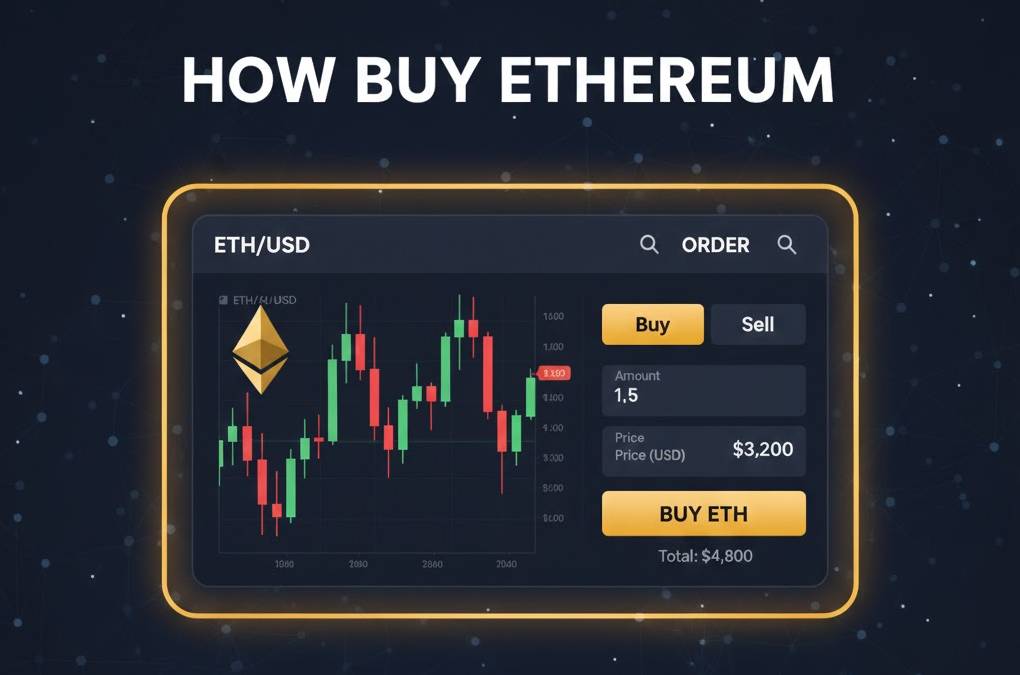
How to Buy Ethereum: Complete Beginner's Guide
Complete guide to buying Ethereum. Learn to choose an exchange, set up accounts, verify identity, and purchase Ethereum securely with step-by-step instructions.
How to Buy Ethereum: Complete Purchase Guide for Beginners
Ethereum is the world's leading smart contract platform. This comprehensive guide shows you how to purchase Ethereum securely, from choosing an exchange to storing your ETH safely.
Why Buy Ethereum?
Before purchasing Ethereum, understand what makes it valuable and unique. Ethereum is a blockchain platform that enables developers to build decentralized applications and smart contracts. While Bitcoin is primarily digital money, Ethereum is programmable money with vast applications beyond simple transactions.
Key Uses of Ethereum
- DeFi (Decentralized Finance): Lending, borrowing, and trading without banks
- Smart Contracts: Automated agreements that execute code when conditions are met
- NFTs (Non-Fungible Tokens): Unique digital assets representing art, collectibles, and more
- Staking: Earning rewards by validating transactions on the network
- Layer 2 Solutions: Scaling applications that reduce costs and increase speed
For a deeper understanding, read our guide on Ethereum Explained.
Preparation Before Buying Ethereum
Understand the Risks
Like all cryptocurrencies, Ethereum is volatile. Prices can swing 20-50% in a single day. Only invest money you can afford to lose completely. Never invest based on hype or FOMO (fear of missing out).
Determine Your Budget
Decide how much you're willing to spend. You don't need to buy 1 whole Ethereum—you can buy fractions. Even 0.01 ETH (roughly $20-100 depending on price) is a valid purchase.
Security Preparation
- Update your operating system and security software
- Use a device with antivirus protection
- Avoid public WiFi when making purchases
- Enable two-factor authentication on all accounts
Research Exchanges
Different exchanges have different features, fees, and security records. Take time to research your options before committing.
Step 1: Choose an Ethereum Exchange
The first critical step is choosing a reputable cryptocurrency exchange. The same major exchanges that sell Bitcoin also sell Ethereum.
Top Ethereum Exchanges
| Exchange | Fees | Minimum | Best For |
|---|---|---|---|
| Coinbase | 1.49% - 3.99% | $1 | Beginners, US users |
| Kraken | 0.16% - 0.26% | $10 | Active traders, advanced users |
| Binance | 0.1% - 0.55% | $5 | High volume, international |
| Gemini | 1.49% - 1.99% | $1 | Security-focused, regulated |
| Crypto.com | 0.04% - 0.04% | $1 | Rewards program, low fees |
| FTX US | 0.1% - 0.1% | Any | Derivatives, advanced features |
Exchange Selection Criteria
1. Security and Reputation
Check the exchange's security track record. Look for:
- History of security breaches
- Insurance coverage for user funds
- Cold storage of customer assets
- Two-factor authentication support
2. Regulatory Compliance
Regulated exchanges provide better consumer protection. In the US, look for Money Services Licenses (MSL) or registration with FinCEN. Worldwide, check if the exchange complies with local regulations.
3. Fee Structure
Compare all fees:
- Trading fees: Percentage charged per purchase
- Deposit fees: For adding funds to the account
- Withdrawal fees: For moving Ethereum off the exchange
- Staking fees: If you plan to stake Ethereum
Lower isn't always better—sometimes higher-fee exchanges have better security or features.
4. Supported Payment Methods
Ensure your preferred payment method is available:
- Bank transfers (lowest fees, slowest)
- Credit/debit cards (fast, higher fees)
- PayPal (convenient, may have limits)
- Wire transfer (for large amounts)
5. User Interface and Support
As a beginner, choose an exchange with an intuitive interface and responsive customer support. Test the platform's help resources before funding your account.
6. Availability in Your Country
Some exchanges don't operate in all countries due to regulatory restrictions. Verify your country is supported before starting the signup process.
Step 2: Create Your Exchange Account
Sign Up with Real Information
Go to the exchange's official website (bookmark it to avoid phishing). Click "Sign Up" or "Register" and provide:
- Email address (use a primary email you check regularly)
- Password (create a strong, unique password 16+ characters with uppercase, lowercase, numbers, and symbols)
Verify Your Email
Check your email for a verification message. Click the link to confirm your email address. This proves you have legitimate access to the email account.
Enable Two-Factor Authentication (2FA) Immediately
This is non-negotiable for security. 2FA requires two forms of authentication to log in:
- Authenticator apps: Google Authenticator, Microsoft Authenticator, or Authy (most secure)
- SMS: Codes sent to your phone (less secure but better than nothing)
- Backup codes: Get these and store them securely in case you lose your phone
To enable 2FA:
- Download an authenticator app (Google Authenticator or Authy recommended)
- In your exchange account settings, find "Security" or "Two-Factor Authentication"
- Scan the QR code with your authenticator app
- Save your backup codes in a secure location (not on your computer)
- Enter a code from your app to confirm setup
Step 3: Complete Identity Verification (KYC)
Regulated exchanges require Know Your Customer (KYC) verification to prevent money laundering and fraud.
Provide Personal Information
Enter your:
- Full legal name (as it appears on government ID)
- Date of birth
- Country of residence
- Residential address
- Phone number
Accuracy is crucial—information will be verified against official records.
Upload Government ID
Provide a clear photo or scan of your:
- Passport
- Driver's license
- National ID card
- Residence permit
Make sure the document is:
- Not expired
- Clearly legible (good lighting, no shadows)
- Shows your full face and identifying information
Proof of Address
Upload a document showing your residential address, typically from the last 3 months:
- Utility bill (electric, water, gas)
- Bank statement
- Government correspondence
- Lease or rental agreement
Facial Verification
Many exchanges require facial recognition. You'll take a selfie or video to prove you're the person in your ID document. This usually takes just a few minutes.
Wait for Approval
Verification typically completes within 1-24 hours. During busy periods, it may take longer. You'll receive an email when your account is fully verified.
Step 4: Add a Payment Method
Now that your account is verified, add a way to fund your purchase.
Bank Transfer (ACH, SEPA, or Wire)
Advantages: Lowest fees (often free or under 1%), no daily limits
Disadvantages: Slowest (3-7 business days), requires sharing bank details
Process: Link your bank account by providing account and routing numbers. The exchange will send micro-deposits (often $0.01) to verify ownership. Confirm these amounts in your bank account, then your account is fully linked.
Debit or Credit Card
Advantages: Instant funding, immediate purchase
Disadvantages: Highest fees (2-5%), daily limits ($100-5000 depending on card), card may decline crypto purchases
Process: Enter your card number, expiration date, CVV, and billing address. Some exchanges require 3D Secure verification (an extra security prompt).
Other Payment Methods
- PayPal: Mid-level fees, moderate speed
- Apple Pay/Google Pay: Fast, good security
- Gift cards: Some exchanges accept gift cards (often with high fees)
Tips for Adding Payment Methods
- Start with bank transfer for lowest fees if you can wait
- Use credit/debit card only if you need immediate access
- Never use credit cards if it will charge interest (treat crypto purchases like cash)
- Keep personal and crypto finances separate when possible
Step 5: Purchase Your Ethereum
You're ready! Time to buy your first Ethereum.
Navigate to Buy/Trade Section
On your exchange dashboard, find the "Buy," "Trade," or "Quick Buy" section. Make sure you're selecting Ethereum (ETH), not Ethereum Classic (ETC) or another similar token.
Choose Your Purchase Method
You can usually buy in two ways:
Market Order
Buy Ethereum immediately at the current market price. You specify how much fiat currency to spend (e.g., $100), and the exchange shows you exactly how much ETH you'll receive. This is fastest and recommended for beginners.
Limit Order
Set the price you're willing to pay and wait. The purchase executes only when Ethereum falls to that price. More advanced and not recommended for first-time buyers.
Enter the Purchase Amount
Decide how much to invest. For your first purchase, start small—$10-100 is perfect for learning. You don't need to buy whole Ethereum. For example:
- $50 might buy you 0.025 ETH (if ETH costs $2000)
- $100 might buy you 0.05 ETH
- Fractional ownership is completely normal
Review the Details
Before confirming, verify:
- Amount in USD/EUR/GBP: How much you're spending
- Amount in ETH: How much Ethereum you'll receive
- Current ETH price: The price used for your purchase
- Fees: All applicable charges
- Total cost: Final amount you'll be charged
- Payment method: Where the money is coming from
Confirm Your Purchase
Click "Buy Ethereum," "Confirm," or similar button. You'll likely need to:
- Enter your 2FA code
- Confirm your payment method details
- Accept terms and conditions
Processing and Confirmation
Your purchase will process—this typically takes seconds to minutes for market orders, but can take longer for bank transfers. You'll see your Ethereum appear in your exchange wallet.
You'll receive a confirmation email with:
- Order ID
- Amount purchased
- Price per ETH
- Transaction hash (for blockchain verification)
- Timestamp
Step 6: Store Your Ethereum Safely
Leaving Ethereum on an exchange is convenient but risky. For security, consider moving it to your own wallet.
Storage Options
Leave It on the Exchange
Best for: Active traders, beginners
Pros: Easy to buy/sell, convenient, exchange insured
Cons: Counterparty risk if exchange is hacked, you don't control private keys
Hardware Wallet
Best for: Long-term holders, large amounts
Pros: Maximum security, keys kept offline
Cons: $50-150 cost, less convenient for trading
Options: Ledger Nano S/X, Trezor Model T
Software Wallet
Best for: Regular users, moderate amounts
Pros: You control keys, no cost, fairly secure
Cons: Can be hacked if device is compromised
Options: MetaMask, Exodus, Trust Wallet
Paper Wallet
Best for: Ultra-secure cold storage
Pros: Unhackable, completely offline
Cons: Inconvenient, requires careful physical security
How to Transfer Ethereum to Your Wallet
Here's the step-by-step process:
- Open your personal Ethereum wallet (e.g., MetaMask)
- Find your wallet address (usually displayed at the top, a string starting with "0x")
- Copy your address (click to copy, don't type manually)
- Go to your exchange account
- Find "Withdraw" or "Send"
- Select Ethereum (ETH)
- Paste your wallet address in the recipient field
- Enter how much ETH to transfer
- Review carefully—check the address one more time
- Confirm the transfer (may need 2FA code)
- Pay the network gas fee (fee charged by Ethereum network)
- Wait for confirmation (usually 1-15 minutes)
Important: Don't Send to the Wrong Address
Ethereum transactions are irreversible. If you send to the wrong address, your Ethereum is lost forever. Always:
- Copy-paste addresses instead of typing
- Double-check the address before confirming
- Send a test transaction with a small amount first
- Never use addresses from email or messages (they could be altered)
After Your Purchase: What's Next?
Monitor Your Investment
You can track your Ethereum on etherscan.org or through your wallet app. Set price alerts if you want notifications about significant price changes. However, don't obsess over daily price movements.
Secure Your Keys
If you moved Ethereum to a software wallet, you'll have a seed phrase (12-24 words). This is the master key to your funds. Write it on paper, store copies in multiple safe locations, and never share it.
Learn About Staking
Ethereum allows you to stake your ETH to earn rewards while helping secure the network. If interested, research staking requirements and options.
Continue Learning
Read our guides on What Are Cryptocurrencies and Blockchain Explained to deepen your understanding.
Explore DeFi Carefully
With Ethereum, you can access DeFi (decentralized finance) applications. Be extremely cautious—many are risky or scams. Only use audited, established protocols.
Common Mistakes to Avoid
Sending to Wrong Address
The #1 mistake. Always triple-check addresses before confirming.
Falling for Scams
Scammers create fake exchange websites, send phishing emails, and impersonate support staff. Never click links in emails or messages—always navigate directly to official websites.
Using Weak Passwords
Hackers can crack weak passwords in minutes. Use 16+ character random passwords.
Ignoring Security
2FA isn't optional—it's essential. Every account should have it enabled.
Panic Selling or Buying
Don't make emotional decisions based on price swings. Have a plan and stick to it.
Ethereum vs. Bitcoin: Which Should You Buy?
Both are popular cryptocurrencies with different purposes:
| Aspect | Bitcoin (BTC) | Ethereum (ETH) |
|---|---|---|
| Purpose | Digital currency, store of value | Smart contracts, DeFi, programmable |
| Supply | Fixed 21 million cap | Unlimited, but limited annually |
| Transaction Speed | ~10 minutes | 12-15 seconds |
| Volatility | Very high | Very high |
| Use Cases | Payment, store of value | Applications, tokens, DeFi |
| First Mover | Yes (2009) | Second major platform (2015) |
Many investors buy both. See our guide on How to Buy Bitcoin for more information.
Tax Implications
In most countries, Ethereum purchases have tax implications:
- Capital gains: When you sell for profit, you may owe capital gains tax
- Income tax: Staking rewards are typically taxed as income
- Record keeping: Keep detailed records of purchase price, date, and amount
- Country-specific rules: Different countries have different regulations
Consult a tax professional for specific guidance based on your location.
Conclusion
Buying Ethereum is a straightforward process: choose an exchange, verify your identity, add a payment method, and purchase. The entire process typically takes 1-3 hours from start to finish.
Remember to prioritize security throughout every step. Use strong passwords, enable 2FA, verify addresses carefully, and consider hardware wallets for significant amounts. Welcome to the world of Ethereum and DeFi!